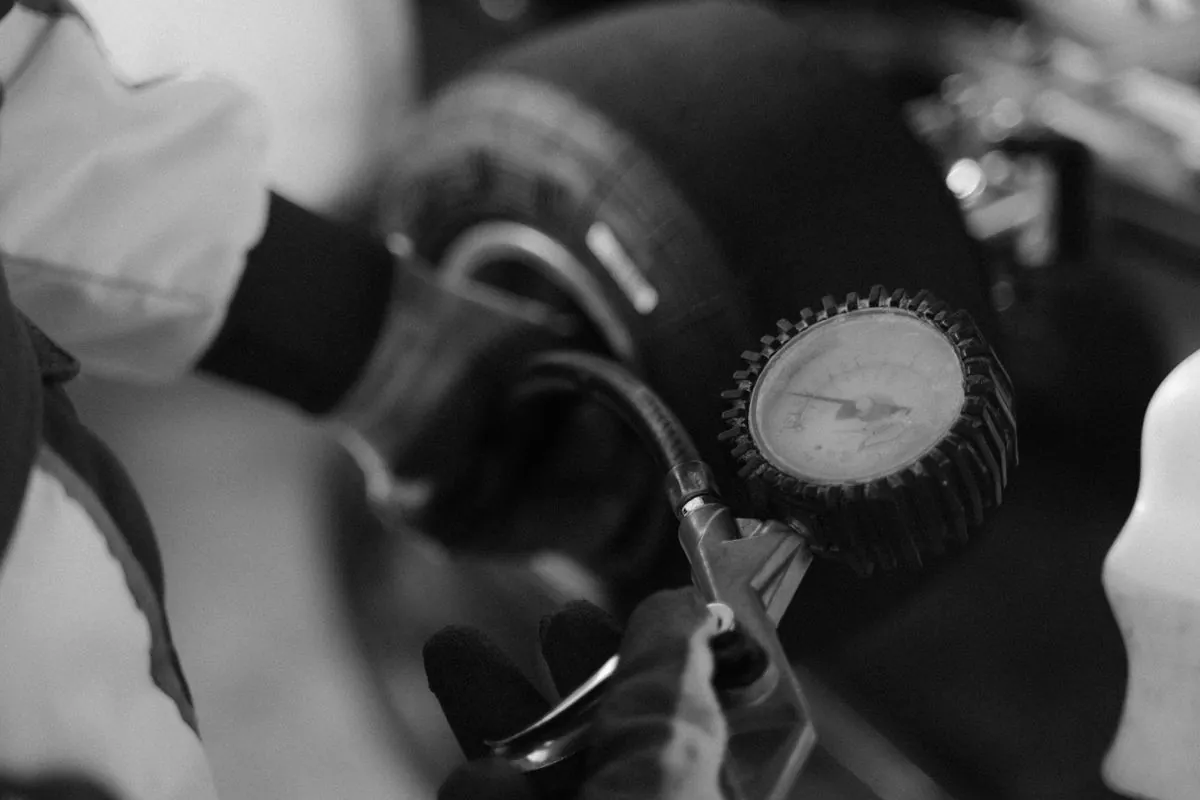
No Vauxhall Astra has a tyre pressure reset button, so clearing the warning is always two jobs rather than one: put every tyre back to the figure on its label while the tyres are cold, then let the car learn that figure in the way your generation expects. On the Astra L built since late 2021, which includes the Astra Electric and the Sports Tourer, Vauxhall's handbook calls that second step system initialisation and you do it through the Info Display. On the Astra K and the Astra J there is nothing to initialise after a top-up at all, because those cars read a sensor inside each wheel and update themselves once you drive.
That difference matters, because most of the advice floating around for Astra owners describes the wrong car. Below, each instruction is tied to the generation and the handbook edition it came from, so you can check it against your own. Every edition quoted is free to download from Vauxhall's Astra owner's manuals page. Where Vauxhall does not print an exact menu name, this guide says so rather than inventing one, and points you at the chapter of your handbook that does.
Which tyre pressure system does your Astra have?
Three Astra generations are still common on UK roads and they warn about low pressure in two completely different ways. Vauxhall changed from wheel sensors to a wheel-speed system when the Astra L arrived, which is the opposite of the direction most people assume.
| Generation | Sold roughly | How it detects low pressure | What the reset actually is | Handbook editions checked |
|---|---|---|---|---|
| Astra L, including Astra Electric and Sports Tourer | Late 2021 onwards | Indirect: deflation detection read from wheel rotation speeds | Initialise the system through the Info Display | March 2023 and February 2026 |
| Astra K | 2015 to 2021 | Direct: a pressure sensor in each wheel | Nothing to initialise after a top-up. Wheels are relearned after a swap | March 2018 and August 2020 |
| Astra J | 2009 to 2015 | Direct: a pressure sensor in each wheel | Nothing to initialise after a top-up. Wheels are relearned after a swap | August 2010 and August 2015 |
| Astra H and older | Before 2009 | Not checked for this guide | Follow your own handbook | Not checked |
The Astra L handbook describes its system as one that "continually checks the rotation speed of all four wheels" and compares each tyre's rolling circumference against stored reference values. Nothing in the wheel measures air. A soft tyre is simply a slightly smaller tyre, so it spins faster than its neighbours and the car raises the alarm from that.
The Astra K and Astra J handbooks describe the older approach, where the system "checks the pressure of all four tyres once a minute when vehicle speed exceeds a certain limit" and can put a real pressure figure on screen for each corner. That gives you a quick way to identify your own car without knowing its generation code: scroll through the driver's display and see whether it will show you four pressures. If it can, you have sensors. If all it ever does is warn, you have deflation detection. Our TPMS warning light explainer carries more on how each design behaves day to day.
What has to happen before you touch any reset
Skip this part and the reset will either fail or make things worse. On the Astra L the initialisation stores whatever is in the tyres as the new normal, so initialising with one soft corner teaches the car that the soft corner is correct and quietly removes the warning you needed. On the Astra K and later Astra J an inaccurate Tyre Load setting moves the threshold the warnings are measured against.
- Find your own figures. All three handbooks point to the tyre pressure information label on the car and a full tyre pressure chart in the technical data chapter, and tell you to identify the tyre size and the engine identifier code before reading a value off it. The August 2010 Astra J handbook places the label on the front left door frame. TyreSafe's page on tyre pressure notes that the figures also appear inside the fuel filler cap or the driver's door sill.
- Measure cold. Vauxhall states that label and chart values are valid for cold tyres at 20 degrees C, and that pressure climbs by nearly 1.5 psi, or roughly 10 kPa, for every 10 degrees C the tyre warms up. Check on a driveway before you set off, not at the services after an hour on the M1.
- Match the load. The chart gives different pressures for a light load and a full one, and the Astra K and Astra J handbooks add an Eco pressure aimed at the lowest fuel consumption. Whichever column you use, the car has to be told the same thing.
- Do not forget the spare. All three handbooks say to check cold pressures at least every 14 days and before any long journey, spare wheel included, and that this still applies to a car with a monitoring system fitted.
- Ignition off on the sensor cars. The Astra K and Astra J handbooks specifically say to switch the ignition off before adding or releasing air on a car with tyre pressure monitoring.
No pressure figures appear in this guide, and that is deliberate. An Astra leaves the factory on several different wheel and tyre combinations, with petrol, diesel, hybrid or battery drivetrains underneath, and the right figure moves with all of them. Read it off your car. For the wider picture there is our correct tyre pressure guide.
How do you reset the light on an Astra L (2021 onwards)?
Vauxhall does not use the word reset for this car. The heading in the handbook is System initialisation, and it applies after a pressure correction or a wheel change so the system can learn fresh circumference reference values. The Astra owner's manual, March 2023 edition prints it as four steps, and the current New Astra owner's manual, February 2026 edition, which covers the plug-in hybrid and the battery electric versions, repeats it word for word:
- Make sure all four tyres have the correct tyre pressure.
- Apply the parking brake.
- Initialise the system via the Info Display.
- Wait for the pop-up indication, which confirms the reset.
Both editions then describe what the car does afterwards. It calibrates to the new pressures as you drive, and Vauxhall says that after a longer drive the system adopts and monitors them. A warning that goes quiet in the first mile is therefore no proof that the learning has finished, and no reason to start pressing things again either.
For the initialisation itself, the handbook cross-refers to its own Info Display chapter, page 86 in the March 2023 edition and page 94 in the February 2026 one. It does not print a menu path in the tyre section, and the screens genuinely differ between the infotainment units Vauxhall fitted to this car. The safest route is that chapter in your own handbook, not a menu name copied off a forum.
Vauxhall also lists exactly when you have to go through it again:
- the tyre pressure has been changed
- the load condition has been changed
- wheels have been swapped or exchanged
The load line catches people out. Loading the boot for a holiday and moving to the fully laden pressures counts as a change, and so does coming back down again afterwards. Two limits are worth knowing as well. The handbook says the system is inoperable while the ABS or the Electronic Stability Control has a malfunction, or while a temporary spare wheel is fitted, and that once the proper wheel is back on you should check the pressure cold and initialise again. It also warns that the system "will not warn instantaneously on a tyre blow out or a rapid deflation" because it needs calculation time, which is a good reason to keep a gauge in the car even on the newest Astra.
Astra K (2015 to 2021): no initialise step, but a Tyre Load setting and a relearn
Because the Astra K measures air rather than wheel speed, a corrected tyre is at once a corrected reading. The Astra owner's manual, August 2020 edition says that after inflating, "some driving may be required to update the tyre pressure values" in the Driver Information Centre, and that the warning light may stay lit during that time. Patience is the procedure.
What the car does need from you is the right load setting. The handbook is blunt that the Tyre Load choice "determines the reference pressures for the tyre pressure warnings", so a car left on Max while the tyres hold comfort pressures is being judged against a higher reference than it is running, and a car left on Light under a full load against a lower one. The menu only appears with the car at a standstill and the parking brake applied, with the selector in P on an automatic, and the three options are:
- Light for comfort pressure with up to three people aboard
- Eco for the Eco pressure with up to three people aboard
- Max for full loading
You reach the tyre pressure and Tyre Load pages in the Driver Information Centre through the vehicle information menu on the turn signal lever, and the handbook gives slightly different wording for the Midlevel and Uplevel displays, so follow whichever matches the cluster in front of you.
Wheel changes are the other half of the story, and this is where Astra K handbooks disagree with each other because Vauxhall changed the hardware during the car's life:
- August 2020 and October 2019 editions: an Auto learn function. After changing wheels or wheel positions the car must sit still for about 20 minutes before the system recalculates, and the relearn that follows takes up to 10 minutes of driving in a speed range of 25 to 60 mph. Vauxhall suggests a country road or similar that lets you drive continuously, and warns that pressure values may swap around on screen while it works. If it fails, a message appears and the warning light flashes for 60 seconds then stays on, and you repeat the whole sequence.
- March 2018 edition: a sensor matching process. The earlier Astra owner's manual, March 2018 edition instead describes matching each sensor's unique identification code to its wheel position with a relearn tool, working left front, right front, right rear then left rear, with two minutes allowed for the first wheel and five minutes overall before the process stops and has to be restarted. It tells owners to consult a workshop for the job.
Both editions agree on the maintenance points that can cause stubborn Astra K warnings. Only wheels with pressure sensors should go on the car, or it cannot display a figure at all and the light stays lit for good. A spare or temporary spare has no sensor, so the light comes on while it is in use, though the other three tyres are still monitored. Every time the tyres are replaced the sensors have to be dismounted and serviced, which means a new valve core and sealing ring on the screwed type and a complete new valve stem on the clipped type. Only original plastic valve caps should be used, because the handbook warns that metal caps lead to valve oxidation and damage. Commercially available liquid repair sealants can impair the system, although factory approved kits are allowed. And if you change to a different tyre or wheel size, the handbook says to have the pressure label replaced and the monitoring system reinitialised.
If a sensor itself has died rather than a tyre going soft, no amount of driving will clear it. Our guide to TPMS sensor replacement explains what that job involves, and tyre valve problems covers the slow leaks that begin at a corroded or badly seated valve.
Astra J (2009 to 2015): Tyre Load, auto learn and sensor matching
The Astra J uses the same idea as the Astra K, a sensor in each wheel reporting a real figure once a minute above a certain speed, with the readings shown in the Vehicle Information Menu of the Driver Information Centre. You reach that menu with the MENU button on the turn signal lever and scroll with the adjuster wheel.
Which procedure applies depends on how old your Astra J is, and the handbooks make that clear:
- Earlier cars, August 2010 edition. The Astra J owner's manual, August 2010 edition describes an Adaptive threshold function, where the system works out for itself whether the car is running pressures for up to three people or for a full load, so there is no Tyre Load menu to set. Its Auto learn function needs the car stationary for about 20 minutes after a wheel change, followed by a relearn of up to 10 minutes of driving at a minimum of 12 mph.
- Later cars, August 2015 edition. The Astra J owner's manual, August 2015 edition adds a Tyre load menu with the same Light, Eco and Max choices as the Astra K, again only available at a standstill with the parking brake applied, and describes a full TPMS sensor matching process. That one runs from the tyre pressure page in the Vehicle Information Menu, is begun with the SET/CLR button, and is confirmed by the horn sounding twice as the receiver enters relearn mode. A relearn tool is then held against the sidewall near the valve stem at each wheel in turn, left front, right front, right rear, left rear, with a horn chirp per wheel and a double chirp at the end. Vauxhall allows two minutes for the first wheel and five minutes for all four, and tells owners to consult a workshop for the service or to buy the tool.
Two Astra J specifics catch people out. The August 2010 handbook says the valve cores and sealing rings must be replaced every time the tyres are changed, so a light that appeared right after a tyre fitting can be a valve issue rather than a pressure one. And if a complete set of wheels without sensors goes on, typically a cheap winter set, the car displays a message, the system stops working and the light stays on. Vauxhall notes that retrofitting sensors is possible.
Steady or flashing: what the Astra warning light is actually saying
The behaviour of the symbol separates a tyre problem from an electrical one, and it is the single most useful thing to notice before you start pumping anything up.
| What you see | Astra L | Astra K and Astra J |
|---|---|---|
| Lit steadily | Tyre pressure loss in one or more wheels. Stop immediately and check the tyre pressure. | Low tyre pressure detected. Stop as soon as possible and inflate the tyres as recommended. |
| Flashing | Fault in the system. Consult a workshop. | Flashes for 60 to 90 seconds then stays lit: a fault in the system, or a wheel with no sensor such as the spare. Consult a workshop. |
| Message on the display | Warning message in the Driver Information Centre alongside the light | Message names the affected tyre |
| Lit on a cold morning, out again after driving | Not described in the Astra L handbook. Treat it as low pressure and check the tyres cold. | The handbook says this can indicate a tyre approaching a low pressure condition. Check it. |
A flashing light is worth taking seriously even though the tyres may be perfectly fine, because it means the car has stopped watching them. Until it is fixed, a gauge and a fortnightly habit are doing the job the system used to do.
Why does the Astra tyre pressure light keep coming back?
A warning that clears after you inflate and then returns within days is not a computer fault. It is air leaving a tyre, and on an Astra there are four places to look.
- Something sharp in the tread. A screw or nail can seal itself well enough to lose only a few psi a week, which is exactly the rate a monitoring system is built to catch.
- The valve. On the Astra K and Astra J the valve is part of the sensor, and Vauxhall wants the core and sealing ring or the whole stem renewed at every tyre change for that reason. A tired valve leaks slowly and constantly.
- The rim seal. Corrosion on an alloy where the tyre bead sits lets air creep out without any visible damage, and kerbed rims are a common starting point.
- The weather. Pressure falls as temperature falls, so an autumn cold snap can push an already marginal tyre below the threshold. Pressure falls roughly 1.5 psi for every 10 degrees C drop, so the first frost can be enough on its own.
There is one failure mode unique to the Astra L. Because the deflation detection system compares the four wheels against each other and against stored references, a tyre that is quietly losing air can be baked in as the new normal by an initialisation, after which the car will say nothing until the leak gets worse. If you have initialised more than once in a month, stop initialising and have the tyre looked at instead.
Is it safe to drive with the light on, and will it fail the MOT?
Vauxhall's own instruction for the Astra L when the warning appears is to reduce speed, avoid sharp cornering and strong braking, stop at the next safe opportunity and check the tyre pressure. The Astra K handbook puts it as stop as soon as possible and inflate the tyres as recommended. Neither says carry on to your destination.
- On a motorway, do not inspect the car on the carriageway. If it handles normally, slow down, leave at the next junction or the next services and look at the tyres somewhere safe; if not, use the hard shoulder or an emergency area. If you feel in danger, call 999. National Highways can be reached on 0300 123 5000.
- Pull over immediately if the car feels wrong. Steering that pulls, a rumble or flapping noise, or a visibly flat tyre means driving on will wreck the sidewall and turn a repairable puncture into a replacement tyre.
- A flashing light is not an excuse to ignore the tyres. Check all four with a gauge until the system is working again.
There is an MOT consequence too. The DVSA MOT inspection manual lists "tyre pressure monitoring system malfunctioning or obviously not working" as a major defect, which is a fail, for M1 vehicles first used on or after 1 January 2012. That covers every Astra L, every Astra K and any Astra J registered from 2012. A light that is on simply because a tyre is low should be sorted before the test rather than explained to the tester.
Getting an Astra checked without driving anywhere
Some of this is a job for a gauge and ten minutes on the drive. Get help instead when:
- the warning returns within days of you setting the pressures and initialising
- one corner always needs more air than the others
- you can see a nail, a cut or a bulge in the sidewall
- the light flashes, or it stayed on after new tyres or a wheel swap
- the tyre is too soft to be driven on
Rescue Tyres does tyres only (fitting, puncture repair and wheel balancing), and does them where the car already sits: a fully mobile service across London, the Home Counties and the Midlands from one base at Brent Cross, NW2. Evenings, nights and weekends are covered when the diary allows, at the same price as a weekday job. The van carries tyre fitting and wheel balancing equipment, so nothing has to be driven anywhere first. Our fitter gauges all four tyres against your car's own label, looks over the valves, the sidewalls and the tread, and repairs punctures to BS AU 159 where the damage falls inside the repairable area. More on that on our puncture repair page. Where a repair is not allowed, we source the right size for your Astra, run-flat and EV fitments included, then fit and balance it on the spot. If the fault turns out to be the monitoring system and not the rubber, you get told that rather than sold a tyre.
The price is confirmed on the call before anything starts, and a realistic arrival time is agreed with you when you ring. Phone or WhatsApp 07473 720871, or book online.
