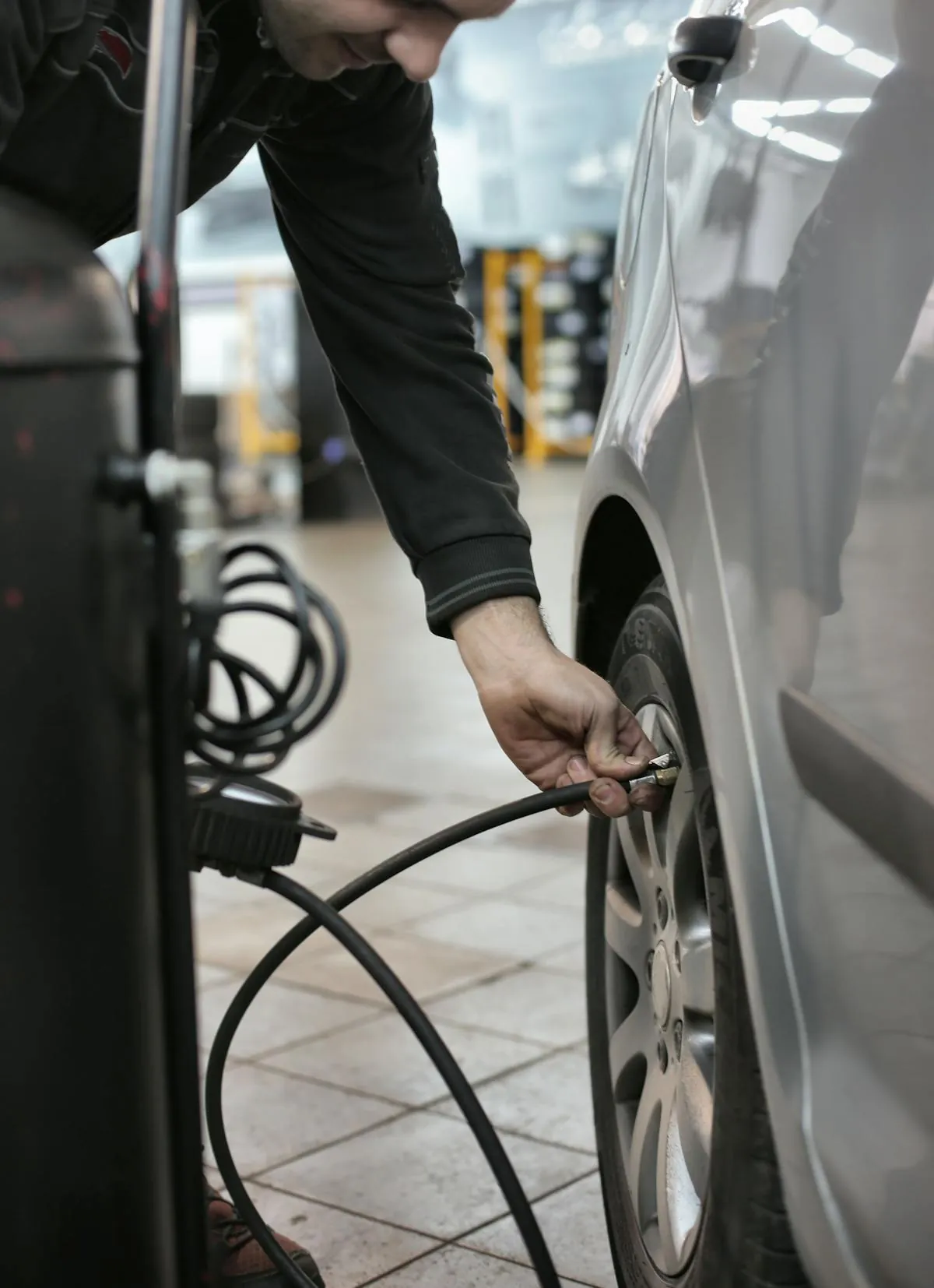
To clear the tyre pressure warning on a Ford Kuga, inflate all four tyres cold to the figures on the tyre information label at the driver side B-pillar, then run Ford's system reset procedure in the instrument cluster menu. On the Kuga sold from 2020 onwards, which Ford lists as the Kuga 2019 generation and which includes the popular plug-in hybrid, the reset is not optional housekeeping. Ford's manual states that you must carry out the reset after each tyre replacement, tyre rotation or adjustment of the tyre pressures, because the car cannot tell which corner each sensor is sitting in and simply assumes you have set the pressures correctly.
The catch is that the menu path changed part way through the generation, and older Kugas use a different system altogether. Everything below is taken from Ford's own UK owner's manuals for the Kuga, with the edition named so you can check it against your car. The two editions used here are the Kuga owner's manual, edition 202104 (vehicles built from 22 June 2021) and the Kuga owner's manual, edition 202206 (vehicles built from 29 August 2022). If your car predates those, use the handbook supplied with it rather than assuming the steps carry over.
Which Kuga do you have, and which system does it use?
Ford splits the Kuga into three generations on its own support site, and the tyre pressure hardware is not the same across them. Work out which one you are sitting in before you start pressing buttons.
| Generation | Ford's name for it | Roughly | How it senses pressure |
|---|---|---|---|
| Kuga Mk3, petrol, EcoBlue diesel, full hybrid and plug-in hybrid | Kuga 2019 | 2020 onwards | A pressure sensor inside each road wheel, attached to the valve stem |
| Kuga Mk2, including the Vignale | Kuga 2012 | About 2013 to 2019 | Varies by build date, check your own handbook |
| Kuga Mk1 | Kuga 2008 | 2008 to 2012 | Indirect, reading wheel rolling circumference through the ABS sensors |
The Kuga Mk3 manual is explicit about the hardware. It says the pressure sensor is located inside the wheel and tyre assembly cavity, that it is attached to the valve stem, and that it is covered by the tyre and not visible unless the tyre is removed. That is why the manual warns you to take care when changing a tyre so the sensor is not damaged, and why it says only to use tyre sealants in roadside emergencies because they can damage the sensor.
There is a quick test if you are unsure. Park up, wake the instrument cluster and look for a tyre pressure page. If the display can show you a pressure figure for each wheel, your Kuga has sensors in the wheels. If it can only warn you, with nothing to read, you are looking at the indirect type. Our explainer on what the TPMS warning light means goes into the difference between the two designs.
Where are the correct Ford Kuga tyre pressures?
Resetting before the pressures are right is wasted effort, because the reset tells the car that whatever it can currently see is the new normal. Get the air right first.
- The label. The Kuga manual says the recommended tyre inflation pressures are on the tyre information label on the driver side B-pillar, and that the label can also be found on the edge of the driver's door. The figures sit next to the tyre size.
- Cold, and every two weeks. Ford says to check all tyre pressures when they are cold, at least once every two weeks. It also advises inspecting each tyre and checking the pressures with a gauge at least once a month and before long trips. TyreSafe's tyre pressure guidance also points drivers to the vehicle handbook and the driver's door area for the correct figures.
- Do not trust the screen as a gauge. The manual carries a warning in bold that you should not use the tyre pressure shown in the information display as a tyre pressure gauge. It is a monitor, not a measuring instrument.
- The spare counts. Ford notes that you probably need to lift the spare wheel out of its well to check its pressure, and the temporary spare on a Kuga runs at a far higher pressure than the road tyres, with the figure given in the manual's tyre pressure table.
- Front and rear can differ. The manual warns that where the label shows different pressures front and rear, the system settings must be updated, which is another reason the reset step matters.
Kuga figures change with wheel size, powertrain and load, and the plug-in hybrid is a heavier car than the petrol, so read them off your own label.
How do you reset the tyre pressure light on a Kuga built from August 2022?
This is the version most people are looking for, because it is the only edition where Ford prints the menu path in full. The Kuga owner's manual, edition 202206 splits the instructions by cluster screen, so check which one you have first. The manual says you must reset the system after each tyre replacement, tyre rotation, or after inflating the tyres to the correct pressure.
Cars with the 4.2 inch instrument cluster display screen:
- Using the information display controls on the steering wheel, select Settings.
- Select Information.
- Select Tyre pressure.
- Select Reset.
- Press and hold the OK button until the system reset confirmation appears.
Cars with the 12.3 inch instrument cluster display screen:
- Press the menu button on the steering wheel to enter the instrument cluster display main menu.
- Select Settings.
- Select Tyre pressure.
- Press and hold the OK button until the system reset confirmation appears.
Two notes from Ford sit alongside those steps and are easy to miss. First, if you have a new sensor or have rotated the tyres, park the vehicle for at least 20 minutes before resetting the system. Second, the system automatically relearns the sensors the next time you drive the vehicle for approximately 15 minutes, so the job is not finished the moment the confirmation appears on screen.
Ford also says that after you inflate the tyres to the correct pressure it may take up to two minutes of driving over 32 km/h, which is 20 mph, for the warning lamp to turn off. A lamp still glowing on the driveway is normal. A lamp still glowing after a proper drive is not.
What about a Kuga built between 2020 and mid 2022?
The earlier Kuga owner's manual, edition 202104 describes the same job in looser language, because those cars were not split by cluster size in print. Its reset procedure reads:
- Switch the ignition on.
- Navigate to the tyre monitor menu in the information display.
- Press and hold the OK button until a confirmation message appears. Ford adds that if your vehicle has a tyre pressure monitoring system reset button, press and hold that button instead until the confirmation appears.
Notice that Ford does not name the exact sub-menus in that edition, so we are not going to invent them for you. On these cars the tyre pressure page lives in the instrument cluster menus you reach with the steering wheel controls, and the confirmation message is the thing to wait for. If your screens look like the ones in the later edition, follow the August 2022 steps above instead.
The trigger list is the same one in both editions. The 202104 manual states plainly that you must carry out the system reset procedure after each tyre replacement or adjustment of the tyre pressures, and that if the tyres are rotated you need to reset the system so it can relearn the positions of the sensors, because the system cannot tell which position a sensor is in and assumes you have set the pressures correctly.
Does the Kuga plug-in hybrid reset any differently?
No. The plug-in hybrid, the full hybrid, the EcoBoost petrol and the EcoBlue diesel all sit in the same Kuga owner's manual, and the tyre pressure monitoring chapter makes no distinction between them. Whichever badge is on the back, the reset is the cluster menu procedure for your build date.
What does change on the electrified Kugas is the kit around the tyre, and that catches people out at the roadside:
- Where the tools live. Ford's manual says that on plug-in and full hybrid vehicles you find the jack and wrench to the left of the spare tyre, while on non hybrid cars they sit under the spare.
- Sealant instead of a spare. Many Kugas carry a tyre sealant and inflator kit rather than a wheel. The manual says the kit is located under the load floor at the rear, that it gives a temporary repair allowing up to 200 km, which is 120 miles, at a maximum of 80 km/h, which is 50 mph, and that the canister holds enough sealant for one repair only.
- Sealant and sensors do not mix. The same manual warns that the use of tyre sealants can damage the tyre pressure monitoring system, and that they should only be used in roadside emergencies. A sealed tyre often means a sensor clean or replacement on top of the puncture.
- Stability control stays on. Ford warns not to switch off stability control or select sport mode while running on a temporary spare or after a sealant repair.
The heavier kerb weight of the plug-in hybrid is also a reason to be fussy about pressures rather than casual. Under-inflation, as Ford's own warning puts it, is the most common cause of tyre failures.
What changes after a new tyre, a wheel swap or the spare going on?
This is where most stubborn Kuga warnings come from. Ford prints a separate procedure for changing wheels, and it has a waiting step in the middle that people skip:
- Make sure all tyres are inflated to the proper pressure, and inflate them if they are not.
- Park the vehicle for at least 20 minutes.
- Carry out the tyre pressure monitoring system reset procedure.
- Drive. The 202104 manual says the system automatically relearns the sensors the next time you drive for approximately 15 minutes above 40 km/h, which is 25 mph.
The temporary spare behaves differently again, and it is meant to. Ford's manual says that when you replace one of your tyres with the temporary spare, the system will continue to identify an issue to remind you to have the damaged road wheel and tyre assembly repaired and put back on the vehicle. In other words the light is doing its job, and no amount of resetting will clear it while the spare is on. Full function returns when the repaired road wheel goes back on and you reset again.
Two more things worth knowing before a tyre is changed. Ford says you should always check the warning lamp after replacing one or more tyres or wheels, to confirm the replacements still allow the system to function. And it warns that a damaged sensor may simply not work, which is why a careful fit matters more on a Kuga than on a car without sensors. Our guide to TPMS sensor replacement covers what happens when the sensor or the valve it sits on is the real fault.
What about the Kuga Mk1 and Mk2?
Older Kugas need their own handbook, and we are not going to pretend the current steps apply to them.
On the Kuga Mk1, sold from 2008 to 2012, the owner's handbook, part number AV4J-19A321-DA (CG3542en), edition 12/2009, describes an indirect system. It uses the ABS sensors to detect the rolling circumference of the wheels, and when the circumference changes, indicating low pressure in a tyre, a warning message is displayed in the information display. There is no pressure reading, because nothing is measuring pressure. That handbook tells owners to reset the system following any adjustment to the tyre pressures or any changing of tyres, to use the multifunction lever to reach the tyre pressure setting and hold the SET or RESET control until the confirmation appears, and, importantly, not to reset the system while the vehicle is moving. The exact wording differs between the Type 2 and Type 3 instrument clusters, so follow the version printed in your own book.
On the Kuga Mk2, sold from about 2013 to 2019, the picture varies with build date, and the European handbooks we checked for that generation (part number CG3585en, editions 11/2012, 02/2014 and 08/2014) do not carry a standalone tyre pressure monitoring chapter at all. That means you cannot assume either the Mk1 or the Mk3 method transfers. Find the wheels and tyres chapter of the handbook that came with your car, or the one matching your build date, and use what it says. If the handbook is long gone, a tyre specialist with a TPMS tool can check whether there are sensors in your wheels.
Why does the Kuga tyre pressure light stay on, or flash?
How the lamp behaves is the diagnosis. Ford's troubleshooting table for the current Kuga reads like this:
| What the lamp does | Ford's stated cause | What Ford says to do |
|---|---|---|
| On steadily | One or more tyres significantly under-inflated | Inflate to the recommended pressure, check the tyres for damage and repair if necessary, then carry out the system reset procedure |
| On steadily or flashing | Temporary spare wheel in use | Repair the damaged road wheel and tyre and refit it to restore correct operation |
| Flashing, then staying on | Monitoring system malfunction | If the tyres are correctly inflated and the spare is not in use, the system has detected a fault that requires service. Have the vehicle checked as soon as possible |
The 202104 edition adds the timing: when the system detects a malfunction the lamp flashes for approximately one minute and then stays continuously illuminated, and that sequence repeats on every subsequent start-up while the fault exists. It also says that when the malfunction indicator is lit, the system may not be able to detect or signal low tyre pressure as intended, so you are back to checking all four with a gauge until it is fixed.
The Kuga's information display messages narrow it further. Tyre pressure low means exactly that. Tyre pressure monitor malfunction means the system itself has a fault. Tyre pressure sensor malfunction points at a sensor, or at the temporary spare being fitted.
Cold mornings are the other common cause, and Ford lists it as a limitation rather than a fault: when the outside air temperature drops significantly the tyre pressure can fall far enough to trigger the lamp, and the fix is to check each tyre, inflate to the recommended pressures and carry out the reset. Our guide to tyre pressure in cold weather explains why autumn catches so many drivers out. If instead the light clears and then returns within a few days, air is still escaping, and that is a slow puncture until proved otherwise.
Driving a Kuga on a soft tyre or sealant
Treat it as a stop and check, not a warning to note for the weekend. Ford's warning on under-inflation is quoted in the plug-in hybrid section above, and the same manual reminds owners that a tyre can lose up to half of its air pressure and not appear to be flat.
- On a motorway, do not stop to look at a tyre: if the car still handles normally, leave at the next junction or services; if it does not, stop in an emergency area or as far to the left as you safely can, get everyone out behind the barrier, and call National Highways on 0300 123 5000, or 999 if anyone is in danger.
- A flashing lamp means the car may not be able to warn you about a genuine pressure loss, so check all four by hand until it is repaired.
- A sealed tyre is temporary. Ford limits a sealant repair to a short distance at reduced speed purely to reach a tyre service location.
There is an MOT consequence as well. The DVSA MOT inspection manual lists a tyre pressure monitoring system that is malfunctioning or obviously not working as a major defect on vehicles first used on or after 1 January 2012, which covers every Kuga Mk3 and any earlier Kuga that has the system fitted. If the lamp is lit only because a tyre is low, set the pressures and run the reset before the test.
When the Kuga reset will not clear it
Have it looked at if:
- the lamp flashes, or stays on after a tyre change, a wheel swap or a sealant repair, even after the 20-minute park, the reset and the 15-minute drive
- one tyre keeps dropping, or you can see a nail, screw, cut or bulge
Rescue Tyres repairs and replaces tyres at the car from one base at Brent Cross, NW2; repairs follow BS AU 159, and if the fault is the monitoring system rather than the tyre we will tell you.
Phone or WhatsApp 07473 720871, or book online. There is more on how it works on our mobile tyre fitting page.
