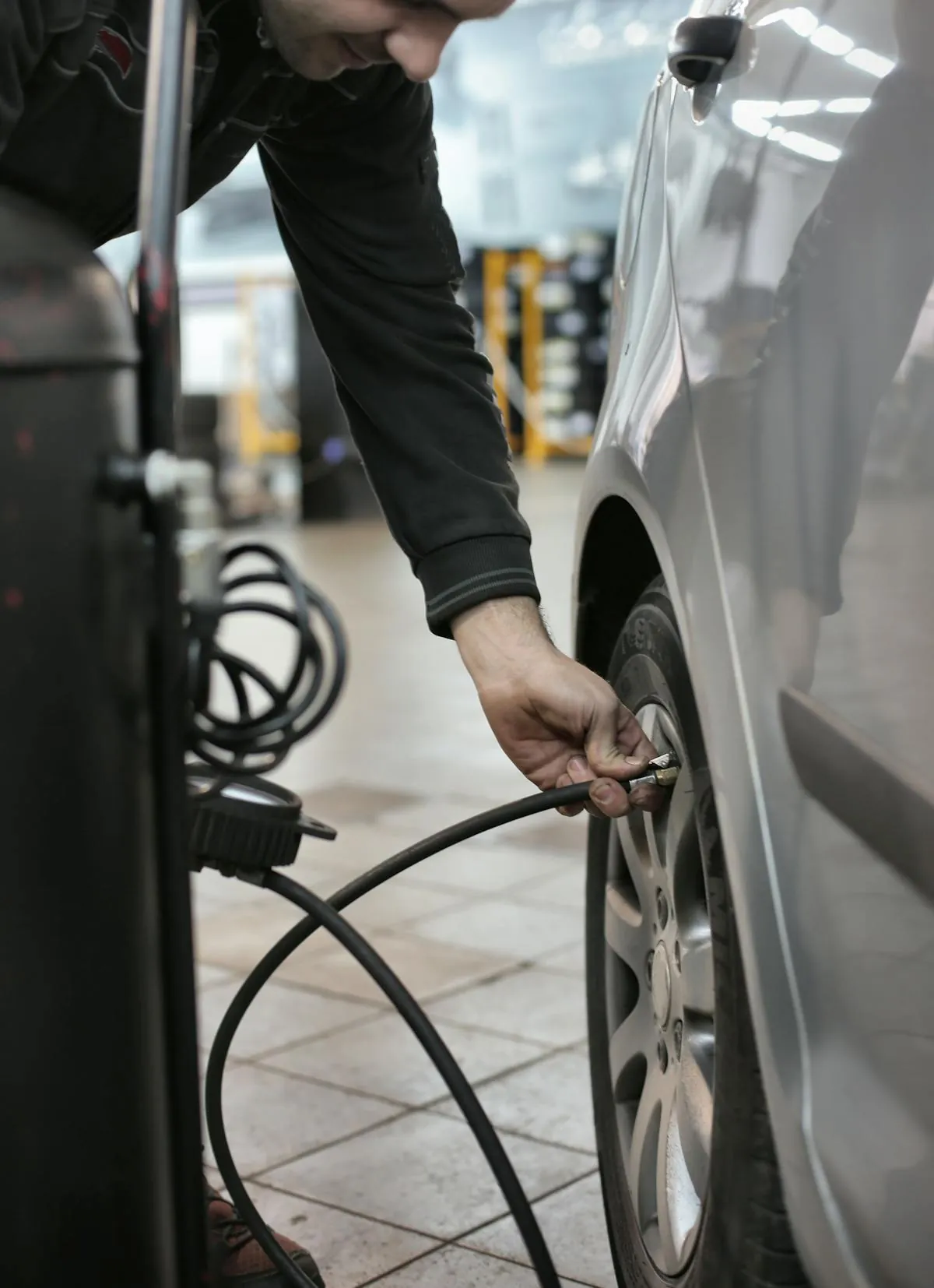
On a Hyundai Tucson there is no reset button and no reset menu. You clear the tyre pressure warning light by inflating all four tyres, cold, to the pressures on the label in the driver's door pillar and then driving the car. Every Tucson from 2015 onwards carries a pressure sensor inside each wheel, so the car is not remembering a reference that needs re-teaching. It is measuring, and the warning goes out when the measurement is right again.
That is the part most people get wrong when they search for a reset. Cars with the other kind of system, which works out low pressure from wheel speeds, genuinely do need initialising through a menu after every pressure change. The Tucson does not, and inventing a menu that is not there is how people end up convinced their car is broken. Every instruction below is taken from the Hyundai UK handbook for the generation named, published on Hyundai's own owner's manuals page.
Which Tucson do you have, and does it monitor pressure?
Hyundai publishes a separate handbook for each Tucson generation sold in the UK, and they do not all describe a monitoring system. This is what each one actually contains:
| Hyundai's own label | Generation | What the handbook describes |
|---|---|---|
| TUCSON 2024 to present | NX4 facelift, petrol, hybrid and plug-in hybrid | Tyre pressure monitoring system, marked "if equipped", with a sensor in each wheel |
| TUCSON 2021 to 2023 | NX4, including the separate hybrid and plug-in hybrid handbook | Tyre pressure monitoring system with a sensor in each wheel |
| TUCSON 2015 to 2020 | TL | Tyre pressure monitoring system, marked "if equipped", with a sensor in each wheel |
| TUCSON 2010 to 2014 | Sold in the UK as the ix35 | The handbook edition checked has no monitoring chapter; late cars registered from November 2014 may differ |
| TUCSON 2004 to 2009 | JM | No monitoring system at all |
The cut-off is not Hyundai being inconsistent. The 2021 onwards handbook prints the European rule that produced it: all vehicles sold in the European market must be equipped with a monitoring system, from 1 November 2012 for a new model and from 1 November 2014 for a current model, based on vehicle registrations. So a 2013 registered ix35 may well have nothing to reset, while everything from the TL onwards does.
The type matters more than the year, though. Because the Tucson reads a sensor in each wheel rather than inferring pressure from how fast each wheel turns, the display can show you a pressure for each corner and the cluster can tell you which tyre is low. If you want the background on the two designs, our explainer on what the TPMS warning light means covers both.
Is there a tyre pressure reset button on a Hyundai Tucson?
No. There is no reset button, no initialise option and no relearn routine in the Tucson handbook for 2015 to 2020, for 2021 to 2023, for the 2021 to 2023 hybrid and plug-in hybrid, or for 2024 onwards. The word reset appears in those handbooks for the trip computer, the power windows and the sunroof. It never appears in the tyre pressure chapter.
What the handbooks describe instead is a sensor mounted inside each tyre behind the valve stem, on every wheel except the spare. The car reads those sensors continuously, so correcting the pressure is the reset. The Tucson owner's manual for 2021 to 2023 puts it plainly: once the original wheel with its sensor is reinflated to the recommended pressure and refitted, the low tyre pressure telltale and the malfunction indicator go off within a few minutes of driving. The 2024 onwards handbook repeats the same sentence word for word, and so does the separate hybrid and plug-in hybrid handbook.
If you have been told to hold a button under the steering column, that advice belongs to a different car. Following it on a Tucson will not do anything, and it will waste the time you should be spending finding out why a tyre went soft.
How do you clear the tyre pressure light on a Tucson?
The sequence below applies to every Tucson with the system fitted, which in practice means 2015 onwards. It is the handbook procedure, not a workaround.
- Check the tyres cold. Hyundai defines a cold tyre as one on a car that has been sitting for at least three hours, or driven less than one mile in that three hour period. Warm tyres read high.
- Read the label, not the internet. The tyre label is on the driver's side centre pillar outer panel, and it gives the pressures recommended for your car. They change with wheel size and load, which is why no figures are quoted here.
- Set all four with a gauge. The handbook is blunt that you cannot tell by looking, because a radial tyre can look fine while under-inflated. Check the spare too if the car has one.
- Do not let air out of a hot tyre. Hyundai warns that warm tyres normally read 4 to 6 psi above the cold figure, and that bleeding them down to the label figure leaves them under-inflated once they cool.
- Refit the valve caps. The handbook asks for this specifically: without the cap, dirt or moisture can reach the valve core and cause a leak.
- Drive. The warning clears itself once the sensors report correct pressures. If the indicators have not gone out after a few minutes of driving, Hyundai's advice is to contact an authorised dealer rather than keep driving and hoping.
One quirk worth knowing on the 2021 onwards cars: the per wheel pressure display does not work when the car is standing still from cold. The handbook says pressures appear a few minutes after driving, and until then the cluster shows a "Drive to display" message. It also warns that the displayed values may differ from what you measure with a gauge, so treat the gauge as the reference when you are setting them.
Where are the Tucson's correct tyre pressures, and how often should you check?
All of this comes from the same handbooks, and it is the part that decides whether the light stays off.
- The label. On the driver's side centre pillar, visible when the driver's door is open. The 2021 onwards handbook describes it as the tyre specification and pressure label.
- How often. Hyundai says to check every tyre, including the spare where one is fitted, monthly when cold, and adds a separate instruction to check tyre pressure once a month or more. Our guide to how often to check tyre pressure covers why monthly is the floor rather than the target.
- Units. If the cluster is showing a unit you do not use, the handbooks say the tyre pressure unit can be changed between psi, kPa and bar in the User Settings mode on the instrument cluster. That is a display preference, not a reset.
- Where to see the readings. On 2015 to 2020 cars the handbook points to the Assist mode on the cluster. On 2021 to 2023 cars it is the Warning mode on the cluster display. Those are Hyundai's own names for the screens, and they differ by generation, so use the chapter in your own handbook rather than assuming.
If a tyre needs topping up every few weeks, that is not a pressure setting problem, it is a leak.
Steady light or flashing light: which problem have you got?
The Tucson uses one symbol for two completely different messages, and telling them apart saves a lot of money. This is how the handbooks describe the behaviour:
| What the light does | What Hyundai says it means | What to do |
|---|---|---|
| Comes on and stays on | One or more tyres is significantly under-inflated. On cars with the cluster display, a position telltale shows which corner | Reduce speed, avoid hard cornering, allow for longer stopping distances, stop and check as soon as it is safe |
| Flashes for about a minute, then stays on | The TPMS malfunction indicator. The system itself has a problem | Have the system checked by an authorised repairer. While it is on, the car cannot warn you properly |
| Does not light at all for three seconds at start-up | Hyundai lists this as a reason to have the system checked | Get it looked at, because the warning you rely on may not be working |
The DVSA describes the same two states in the MOT inspection manual, which applies the TPMS check to cars first used on or after 1 January 2012. It notes that a lamp which stays illuminated after a previous pressure loss "does not automatically mean the system has a malfunction", and that in the event of a malfunction "the lamp may flash a number of times and then remain on". That matches Hyundai's wording exactly, and it is the distinction a tester will be making.
There is one more state the 2021 onwards handbook warns about: if the system is malfunctioning, the position telltale will not appear even when a tyre really is under-inflated. So a flashing light does not just mean a sensor fault, it means the car has stopped telling you about soft tyres as well.
Why does the light stay on after a wheel change or with the spare fitted?
This is where a Tucson owner can end up looking for a reset that does not exist. Hyundai's handbooks explain every case:
- The spare has no sensor. The handbooks state that the spare tyre does not come with a monitoring sensor. Fit it and the low pressure telltale stays on. Drive for about ten minutes above 15.5 mph and the malfunction indicator will blink for a minute and then stay lit as well, because the car can no longer hear a sensor at that corner.
- Putting the original wheel back fixes it. Once the repaired or replaced wheel with its sensor is inflated to the recommended pressure and refitted, both indicators go off within a few minutes of driving on the 2021 onwards cars. No menu, no button.
- Aftermarket wheels usually have nothing inside them. The handbook is direct about this: you must use TPMS specific wheels, and wheels bought on the open market do not have a sensor. Hyundai recommends a sensor approved for the vehicle if you do fit other wheels, and warns that a car without a working system may fail a periodic inspection.
- Sealant and sensors do not mix. Where a Tyre Mobility Kit has been used, the handbook says the sealant on the pressure sensor and wheel should be removed when the tyre is replaced, and the sensors inspected. It also recommends against any puncture repairing agent not approved for the car, because the sealant may damage the sensor.
Practical version: after a puncture or a wheel swap, the light going out is the proof that the sensor at that corner is alive and reading. If it does not go out within a few minutes of driving, something at that wheel needs looking at. Our guide to whether a puncture can be repaired covers what happens to the tyre itself.
What if a TPMS sensor has actually failed?
Sensors do not last forever. They sit inside the wheel behind the valve stem, they take every pothole the tyre takes, and the battery inside them is not replaceable. When one stops reporting, the car reacts the same way it does to a missing sensor: the malfunction indicator blinks for about a minute and then stays on.
Before assuming the worst, the handbooks list several things that make the indicator light without any sensor being broken. It may come on near electric power supply cables or radio transmitters, at police stations, government and public offices, broadcasting stations, military installations, airports and transmitting towers. It may also come on when snow chains are fitted, or when electronic devices such as laptops, chargers, remote starters or navigation units are used in the car. If it clears on the next journey away from whatever caused it, nothing is wrong.
If it keeps coming back, Hyundai's own list of symptoms worth having checked is short and specific: the light not illuminating for three seconds when the car is switched on, the malfunction indicator remaining lit after blinking for about a minute, and the position telltale remaining lit. Any of those three, and the system needs diagnosing rather than guessing at. What that involves is covered in our guide to TPMS sensor replacement, and a corroded or badly fitted valve can also cause a slow leak, so have the valve checked too.
Why does the Tucson tyre pressure light keep coming back?
Two causes account for almost all of them, and only one is a fault.
The weather. Hyundai prints a caution about exactly this: in winter or cold weather the low tyre pressure telltale may illuminate if the pressures were set in warm weather, and that does not mean the system is malfunctioning, because a drop in temperature lowers tyre pressure proportionally. The handbook tells you to check and adjust the pressures when you move between warm and cold areas, or when the outside temperature is much higher or lower than it was.
A leak. If you set the pressures correctly, the light goes out, and it returns within days, air is still escaping. The usual culprits are a nail or screw in the tread, a valve that is leaking, or a poor seal between the tyre bead and the rim. A sensor cannot fix that and neither can a reset. Treat it as a slow puncture until it is proved otherwise, and check the valve as well as the tread.
One thing the system cannot do for you, in Hyundai's own words, is warn about severe and sudden tyre damage caused by external factors such as nails or road debris. It is a monitor, not a guarantee, and the handbook says plainly that it is not a substitute for proper tyre maintenance.
What Hyundai's handbook says to do when the light comes on
Not for long. The handbook instruction when either telltale illuminates is to immediately reduce speed, avoid hard cornering, anticipate increased stopping distances, and stop and check the tyres as soon as possible. Hyundai adds that significantly low pressure makes the vehicle unstable, can contribute to loss of control and increased braking distances, and that continued driving on low pressure tyres can cause them to overheat and fail.
- On a motorway, do not stop on the carriageway to inspect a tyre. Slow down and, if the car still handles normally, leave at the next junction or services and check it there; if it does not, pull onto the hard shoulder or into an emergency area and wait behind the barrier. If you feel in danger, call 999. National Highways can be reached on 0300 123 5000.
- Stop straight away if the steering pulls, you hear rumbling or flapping, or the tyre is visibly flat. A deflated tyre destroys its own sidewall within a very short distance, which turns a repairable puncture into a replacement tyre.
- A flashing light means the car may not be able to warn you at all, so check all four with a gauge until it is fixed.
There is an MOT consequence too. The DVSA MOT inspection manual lists a tyre pressure monitoring system that is malfunctioning or obviously not working as a major defect, for M1 vehicles first used on or after 1 January 2012. That covers every Tucson from the TL onwards. A tyre that is obviously under-inflated is recorded as a minor defect in its own right.
Getting a mobile fitter to sort it
Call rather than pumping the tyre up for a third time if:
- the warning returns within days of setting the pressures correctly
- one tyre keeps losing air, or you can see a screw, a cut or a bulge
- the light flashes, or stays on after a tyre or wheel change
- the tyre is too soft to drive on safely
Rescue Tyres is a mobile tyre service working from one base at Brent Cross, NW2. London and the Home Counties are closest; further out, call and we will tell you whether we can take the job. Evenings and weekends are covered when the diary allows, and the price is the same at any hour. A fitter checks all four pressures against the label on your car, inspects the tread, sidewalls and valves, and repairs punctures to BS AU 159 where the damage is in the repairable area. If the tyre cannot be repaired, a replacement in the correct size is fitted and balanced where the car is parked. If the problem turns out to be the monitoring system rather than the tyre, you will be told that plainly instead of sold a tyre you do not need.
The price is confirmed on the call before any work starts, and a realistic arrival time is agreed on the call. Phone or WhatsApp 07473 720871, or use the Book button below. More on how it works on our mobile tyre fitting page.
