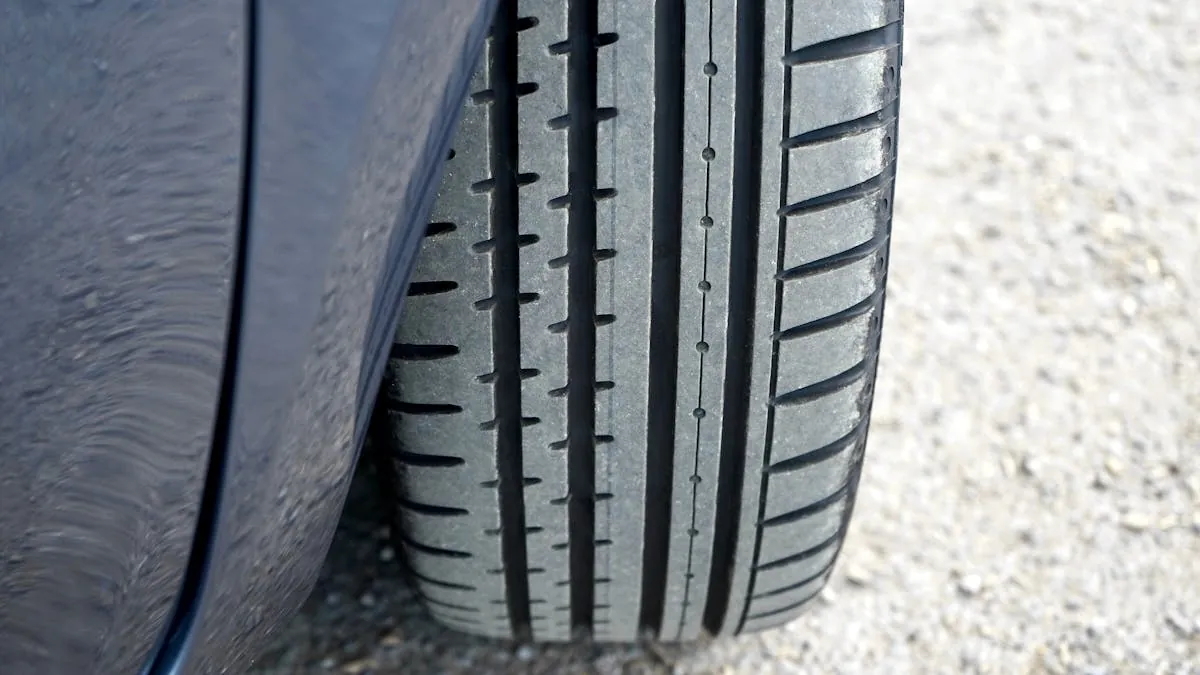
The 20p test is the fastest free way to check whether your tyres are road-legal. Place a 20p coin into the main tread grooves of your tyre. If the outer band of the coin is obscured, your tread is above the legal limit. If it is visible, the tyre may be illegal and should be checked by a tyre professional. It takes under a minute per tyre and needs nothing but a coin.
Why the 20p coin works
The raised outer band of a UK 20p coin gives a quick guide to the legal minimum of 1.6mm: if the band disappears into the groove, there is more tread than the law requires at that point. Tyre-safety charity TyreSafe recommends it as a quick check. It's an indicator, not a legal measurement, so a borderline result needs a proper reading with a tread depth gauge.
How to do the 20p test
It's genuinely a 30-second job per tyre:
- Park safely and make sure the tyre is cool and clean.
- Insert a 20p coin into a main groove around the centre of the tyre.
- Check whether the outer band of the coin is visible. If it is, get the tyre inspected.
- Repeat at the inner edge, centre and outer edge, and at three points around the tyre.
Turn the steering to full lock to see the inner and outer edges of the front tyres properly. For the rears, a phone torch and a crouch is enough. If the coin's band shows anywhere, that tyre needs a proper measurement, even if the other spots look fine.
Test every tyre, in several places
Tyres rarely wear evenly. Worn shoulders often point to under-inflation or alignment problems, while a worn centre strip suggests over-inflation. Checking multiple points catches a tyre that's legal in the middle but bald at the edge, which is one of the most common MOT surprises. The inner shoulder is the one to watch, because it's the hardest to see and the first to go on a car with slight misalignment. While you're there, look for cracks, bulges and embedded nails too.
When the 20p test isn't enough
The 20p test is brilliant as a quick screen, but it has limits. It tells you roughly whether you're above the legal limit, not your exact tread depth, and it won't reveal a tyre that's legal on tread but unsafe for another reason, such as age, a sidewall bulge or internal damage. If the coin's outer band shows even at one point, treat that as a prompt to have the tyre measured properly with a gauge by a fitter, who can also check condition and age. Think of the coin as the smoke alarm, not the full inspection. For anything borderline, a proper measurement settles it.
What the law says, and what the MOT checks
The legal minimum for a car tyre in the UK is 1.6mm of tread across the central three-quarters of the width, around the whole circumference. Each tyre below that limit can bring a fine of up to £2,500 and three penalty points, so four worn tyres can cost a licence.
The rules are set out on the Highway Code (Annex 6), and our guide to illegal tyre fines and penalty points covers what happens if you are stopped.
The MOT tester measures tread depth as part of the test. Below 1.6mm in the central three-quarters is a fail. A tyre that is legal but close to the limit will usually earn an advisory on the certificate, which is a prompt rather than a penalty, but it tells you the tyre will not see another year.
The tester also fails tyres for cuts, bulges, exposed cords and the wrong size or type across an axle.
The 20p test is a quick check against the legal line, not an early warning. If the coin's band is showing, the tyre may already be illegal, so have it measured before you drive far on it. To plan a replacement before it gets that low, use a tread depth gauge, as below.
Tread wear indicators: the check built into the tyre
Every road tyre has small raised bars moulded into the bottom of the main grooves at 1.6mm, so you can see the legal limit without a coin. Look for the letters TWI, a small triangle or a brand symbol on the shoulder of the tyre; they point across the tread to where the bars sit.
There are usually six to eight sets spaced around the tyre.
Run a finger across a groove. While the tread stands proud of the bar, the tyre is above the limit at that point. When the tread surface is flush with the bar, the tyre is at 1.6mm and illegal from then on.
The bars are a hard limit marker, not an early warning. For an early warning, measure the depth with a tread gauge.
Check the bars in the same three places across the tread as the coin test. A tyre that is flush on the inner shoulder and healthy in the middle is still illegal, and it is exactly the kind of wear an alignment problem produces.
Winter tyres often carry a second, taller indicator, sometimes marked with a snowflake, showing the depth below which the tyre stops working properly in snow.
Using a tread depth gauge
A tread gauge costs a few pounds and gives you a number rather than a rough yes or no. Push the probe into a main groove until the base sits flat on the tread blocks, read the scale, and repeat across the width and around the tyre.
Measure in the grooves, not on top of a wear bar, and keep the gauge square to the tyre.
| Reading | What to do |
|---|---|
| 6mm to 8mm | New or nearly new. Check pressures and carry on. |
| 4mm to 5mm | Healthy. Note the figure and check again in a few months. |
| 3mm | Wet grip is starting to fall. Plan a replacement, sooner if winter is coming. |
| 2mm | Replace soon. Avoid long wet motorway trips on it. |
| 1.6mm or below | Illegal. Do not drive on it. |
Write the readings down with the date. A tyre that has gone from 5mm to 3mm in a year tells you roughly when it will reach 2mm, and a big gap between the two front tyres or between the inner and outer edge of one tyre is a fault to investigate rather than just a tyre to replace.
Our guide to when to replace tyres pulls the thresholds together.
How fast tread wears, and when to check again
A new tyre generally starts with 7mm to 9mm of tread, according to TyreSafe, and how quickly that goes depends on the car, the driver and the tyre far more than on the mileage alone.
A heavy, powerful car driven briskly can wear a soft performance tyre out in well under a year; a light car on a hard-wearing touring tyre may go several years on the same set.
On most front-wheel-drive cars the fronts wear noticeably faster than the rears, because they steer, drive and do most of the braking. Swapping tyres between axles at intervals evens this out and lets you replace all four together.
Under-inflation, hard cornering and misalignment all shorten the life further, so correct pressures and smooth driving make the biggest difference.
A monthly 20p check, plus one before any long trip, catches a tyre that has reached the legal limit. Once a tyre reads 3mm, check it monthly with a gauge so the replacement happens on your terms rather than after an MOT fail or a wet-road scare.
Failed the test? Don't risk it
If any tyre is borderline, replace it rather than gambling on the next MOT or a wet motorway. We can supply budget and premium tyres, and our mobile fitters fit them at homes and workplaces from one base at Brent Cross, NW2, so you can swap a worn tyre on your own driveway. London and the Home Counties are closest; further out, we tell you on the call whether we can take the job. Book online or call us, and the arrival time is confirmed on the call.
