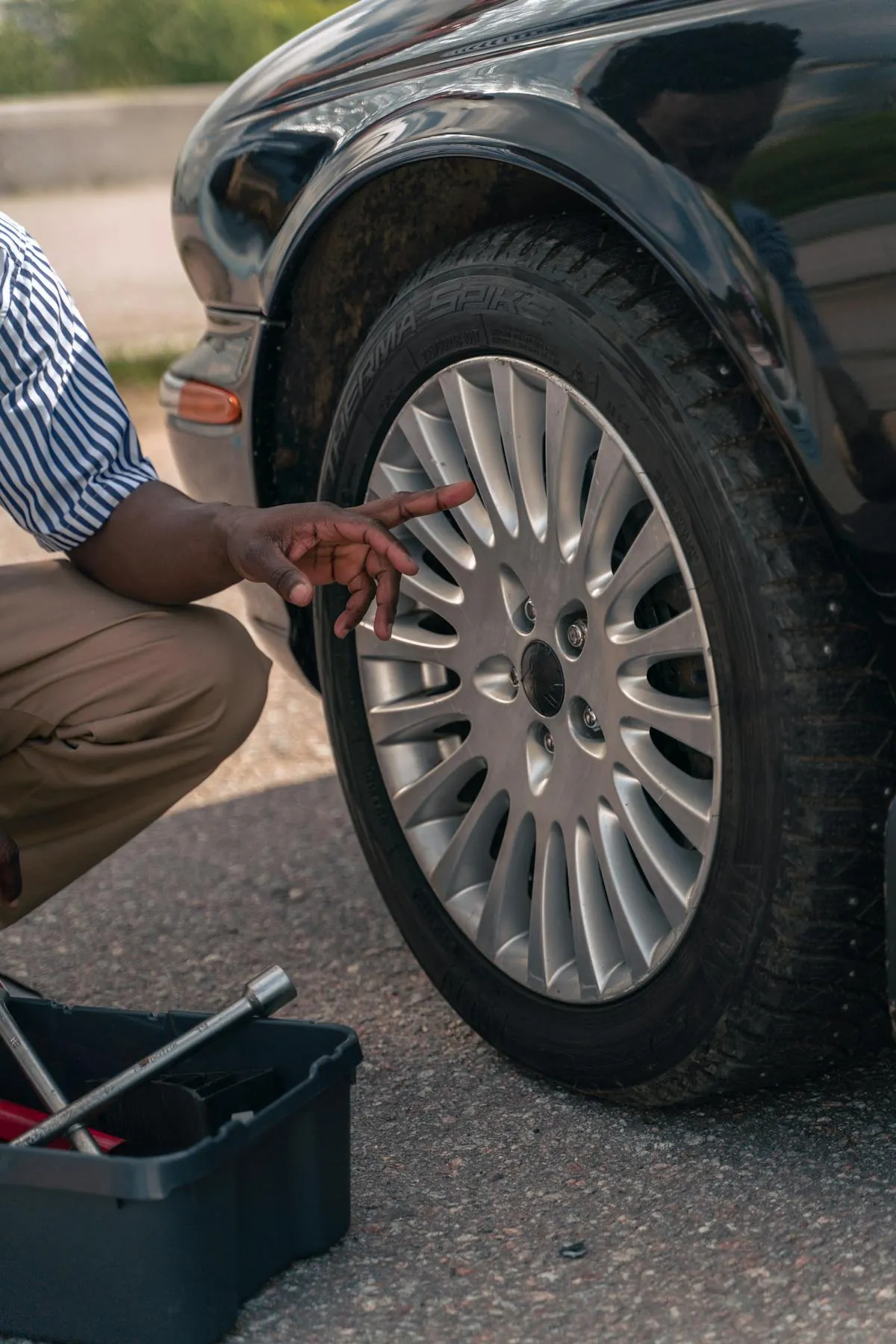
Tyres are one of the most common reasons cars fail their MOT, and almost every tyre failure is avoidable. The MOT tyre inspection covers tread depth, size and type, physical condition and the tyre pressure monitoring system (TPMS). A quick pre-check at home a week before the test can save you a failure, a retest and a wasted trip.
What the MOT checks on your tyres
The tester works through a defined list, set out in the MOT rules (GOV.UK). On your tyres, that means:
- Tread depth – at least 1.6mm across the central three-quarters, all the way round.
- Condition – no deep cuts, bulges, lumps or cords showing. Any sidewall damage is an automatic fail.
- Size and type – correct for the vehicle, and not mismatched across an axle.
- TPMS – on cars first used from 2012, a faulty tyre pressure warning light is a fail.
- Valve condition and secure, undamaged seating.
The faults that catch people out
Uneven wear is the big one. A tyre can read fine in the middle but be bald on an inner edge you can't easily see, usually due to poor alignment. Mixing radial and cross-ply tyres, or fitting different sizes on the same axle, will also fail. So will a tyre that's the wrong speed or load rating for the car. None of these are obvious unless you look, which is why a tyre that "seems fine" still fails surprisingly often.
How to pass first time
A week before your MOT, do the 20p test on all four tyres, including the hidden inner edges, check pressures against the figure in your door sill, and look for cracks or bulges. If anything is marginal, replace it before the test rather than after, when you can't legally drive on it anyway. Doing it a week ahead leaves time to get any borderline tyre changed without the pressure of a failed test and a booked retest.
What happens if you fail
If a tyre is the reason for a fail, you can't legally drive on it once the old MOT has expired, and a tyre below 1.6mm or with a dangerous defect is illegal regardless. That means the safe route is to have the tyre replaced where the car is, rather than driving it to a tyre shop. A fail also means a retest, which is usually free or reduced if done within a set window at the same garage, so getting the tyre sorted quickly keeps the retest simple. The key point is not to drive away on a tyre that failed for being illegal.
Failing on tyres? We'll come to you
If your tyres won't pass, our mobile tyre fitting service brings replacements to your home or workplace, so you can retest without driving on illegal rubber. Book a slot with no deposit.