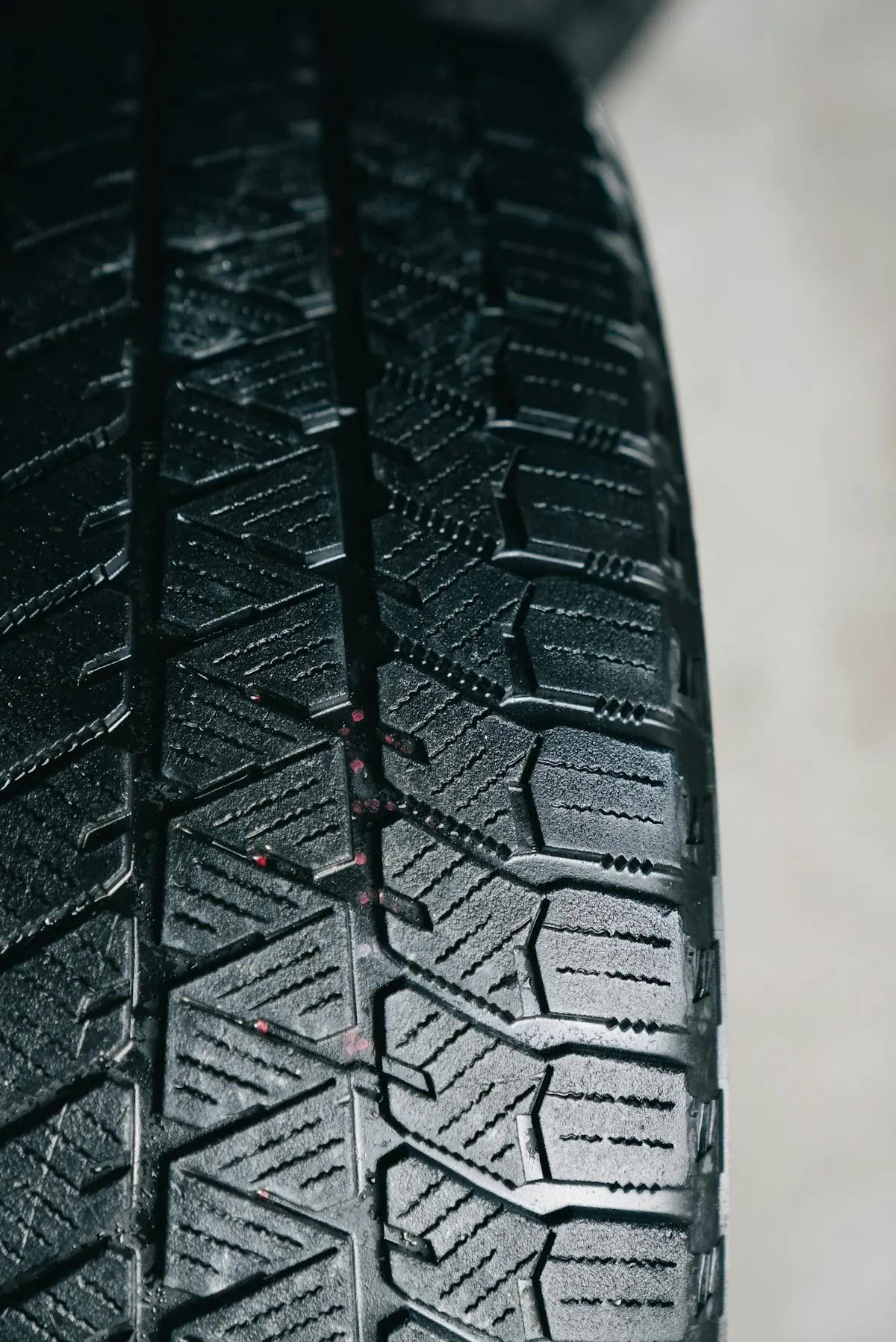
A new car tyre generally has between 7 and 9mm of tread, according to tyre safety charity TyreSafe. The legal minimum in the UK is 1.6mm, and experts commonly advise replacing at 3mm, so from new you have roughly 4 to 6mm of tread to use before it is time to plan new tyres.
Those three numbers answer most of the questions people ask. How long 3mm will last, whether 2mm is safe, or whether you should change at 4mm all come down to how many millimetres you have left and how fast your car uses them. This guide sets out what each depth means, why 3mm is the figure to plan around, a realistic range for how long the last few millimetres last, what speeds wear up, and how to measure your own tyres properly.
How much tread does a new tyre have?
Generally 7 to 9mm. TyreSafe says new tyres "generally have a tread depth of between 7-9 mm", adding that this "will vary depending on the tyre brand, model and whether the tyre was designed for summer, winter or all-season use" (TyreSafe).
That variation is why two new tyres of the same size can measure differently with a gauge, and why the starting figure matters when you compare how long tyres last. A tyre that starts at 7mm has a millimetre less to wear through before 3mm than one that starts at 8mm, even if both wear at the same rate. If you want to know the starting depth for a particular tyre, the manufacturer's data or your fitter can tell you.
New tyres do not come with a stated mileage in the tread itself. How long they last depends on the tyre, the car and the driving, which we cover in our guide to the longest lasting tyres.
What does each tread depth mean?
Anything from new down to 3mm is fine; from 3mm it is time to plan replacement; by 2mm TyreSafe says it should be replaced; below 1.6mm it is illegal. Here is the millimetre-by-millimetre picture.
| Tread depth | What it means | Source |
|---|---|---|
| 7 to 9mm | Typical new car tyre | TyreSafe |
| 4 to 6mm | Part worn but with plenty of tread; keep checking | General guidance |
| 3mm | The minimum commonly advised by tyre and safety experts; plan replacement now | TyreSafe, RAC |
| 2mm | TyreSafe says "you should have your tyre replaced once it reaches 2mm" | TyreSafe |
| 1.6mm | Legal minimum for cars, light vans and light trailers | Highway Code, Annex 6 |
| Below 1.6mm | Illegal, with a fine and three penalty points possible per tyre | TyreSafe, RAC |
The legal rule is precise. The Highway Code says tread must be "at least 1.6 mm across the central three-quarters of the breadth of the tread and around the entire circumference". A tyre can have deep tread in the middle and still be illegal if one section has worn below the limit. Our guide to the UK tread depth law goes into the detail.
At the MOT, the same 1.6mm legal limit is what the tester checks against, as set out in the MOT inspection manual. So 3mm passes an MOT, but passing is not the same as being ready for a wet winter.
Why do experts recommend 3mm when the law says 1.6mm?
Because wet braking gets markedly worse as tread wears towards the legal limit. TyreSafe reports that "in tests carried out by MIRA, cars with 1.6mm tread had up to 44% longer braking distances in the wet than those with 3mm" (TyreSafe). The RAC cites the same finding and says most experts recommend a minimum of 3mm for replacement.
The reason is water. Tread grooves channel water out from under the tyre so the rubber can stay in contact with the road. The shallower the grooves, the less water they can move, and the sooner the tyre starts to ride on a film of water rather than the road. That is also why low tread raises the risk of aquaplaning, which we explain in driving in rain.
Not everyone in the industry agrees. In 2017 Michelin argued that changing tyres at 3mm is unnecessary, costly and harmful to the environment, and that its tyres are designed to perform down to the legal limit (Fleet News). That is a fair point about well designed tyres, and nobody is legally required to replace at 3mm. But the 44% figure is why we, along with TyreSafe and the RAC, suggest planning replacement from 3mm rather than waiting for 1.6mm, especially going into autumn and winter.
How long will 3mm of tread last?
For many cars, a rough estimate is a few thousand miles to reach the 1.6mm legal limit, not tens of thousands. There is no official figure for this, so treat the range below as simple arithmetic from published averages rather than a promise.
The RAC says you should expect "at least 20,000 miles out of your front tyres" and "40,000 for your back tyres" (RAC). If a tyre starts at around 8mm and is worn to 1.6mm over those distances, it uses 6.4mm of tread. That works out at roughly:
| Tyre position (RAC mileage) | Rough miles per mm | 3mm down to 1.6mm (1.4mm) | 2mm down to 1.6mm (0.4mm) |
|---|---|---|---|
| Front, about 20,000 miles | About 3,100 | About 4,400 miles | About 1,250 miles |
| Rear, about 40,000 miles | About 6,250 | About 8,750 miles | About 2,500 miles |
Three caveats matter more than the numbers:
- Your car may wear faster or slower. The RAC's figures are a guide, and the factors in the next section can move them a long way.
- Wear is rarely perfectly even. If one edge wears faster, that edge reaches 1.6mm first, and the tyre is illegal even if the rest has more.
- The legal limit isn't the target. The miles between 3mm and 1.6mm are the ones where wet grip is falling away. Use them to book new tyres, not to see how far they go.
The same arithmetic helps at other depths. A tyre at 5mm has about 2mm to go before 3mm, which on the rough figures above is somewhere around 6,000 to 12,500 miles. Check your own tyres every few weeks and you will soon see your actual rate.
What makes tyres wear faster?
The RAC names three main factors: the quality of the tyre, the road conditions it is used on, and how well it is looked after, including how carefully the car is driven. In practice, these are the ones that make the biggest difference day to day:
- Which axle. The RAC's front and rear figures differ by double, so front tyres on most cars need replacing sooner. Some manufacturers recommend rotating tyres every year or 7,500 miles, whichever comes first, to even this out, the RAC notes.
- Tyre pressure. Under or over inflation concentrates wear on the edges or the centre.
- Alignment. Tracking that is out scrubs one edge of the tread.
- Driving style. Hard acceleration, heavy braking and fast cornering all use tread faster.
- Roads and load. Rough surfaces, lots of short urban journeys and carrying heavy loads all add wear.
Age matters too, even with tread left. The RAC says tyres five years or older should be inspected by a professional at least once a year, and replaced if they are still on the car ten years after manufacture.
How do you measure tread depth properly?
Use a tread depth gauge in the main grooves at several points around each tyre, including near the inner edge, and check the whole central three-quarters of the tread. TyreSafe lists three ways to check: a tread depth gauge, the 20p test and the tread wear indicators built into the tyre (TyreSafe).
- Gauge. The most accurate method. Push the probe into a main groove, not onto a wear indicator bar, and read the depth in millimetres. A gauge gives you an actual number to track over time.
- 20p test. Insert a 20p coin into the main grooves. If you can't see the coin's outer band, the tread is above the legal limit, the RAC explains. It is a quick legal check, but it won't tell you whether you are at 3mm. Our 20p test guide shows how to do it.
- Tread wear indicators. Small raised bars sit in the bottom of the main grooves. When the tread wears down level with them, the tyre is at the legal minimum and needs replacing.
Measure in at least three places around each tyre, because a flat spot or uneven wear can hide in the part you didn't check. The inner edge is easy to miss because you can't see it without crouching down, so check it deliberately. Note the figures each time, and you will know your real wear rate rather than relying on averages.
When should you book new tyres?
Book when any tyre reaches around 3mm, or sooner if it is cracked, bulging or old. Our guide to when to replace tyres covers the other warning signs, and matching wear across an axle matters too.
Rescue Tyres is a mobile tyre service working from one base at Brent Cross, NW2; London and the Home Counties are closest, and for jobs further out we will tell you on the call whether we can take them. We source budget, mid-range and premium tyres to your car's size and fit them at your home or workplace, with wheel balancing done on the van. The price is confirmed on the call before any work, and new tyres carry the manufacturer's warranty. Book online, browse our tyres, or call 07473 720871.
