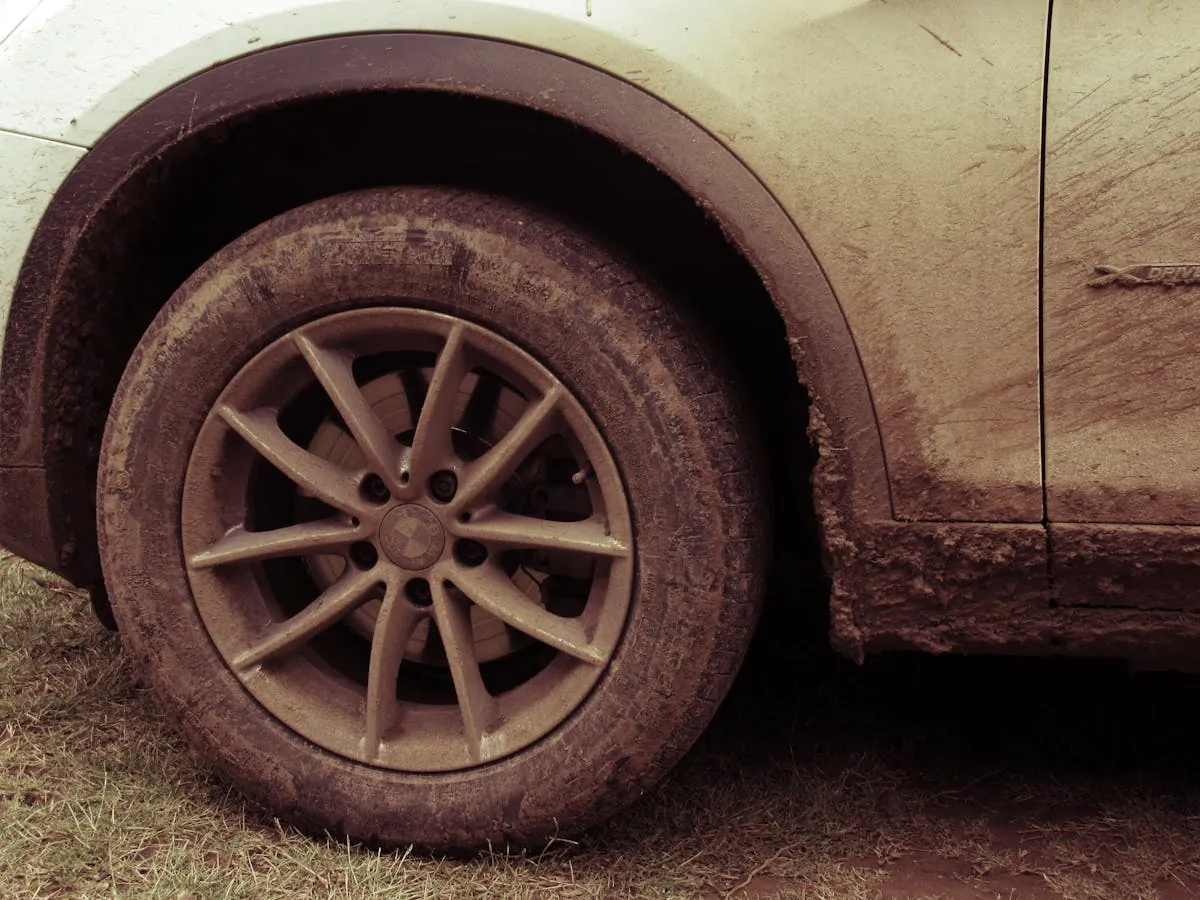
A buckled wheel and an out-of-balance wheel feel similar from the driver's seat, which is why buckles often get misdiagnosed. Both produce vibration. The difference is that a balance problem is corrected with weights in a couple of minutes, while a buckle is a physical distortion of the rim that weights cannot compensate for.
The three symptoms
Buckled wheels announce themselves in one of three ways, and often more than one at once:
- Speed-dependent vibration. It appears around a particular speed and may fade above or below it. Felt through the steering wheel it usually means a front wheel; felt through the seat or floor it usually means a rear.
- A slow leak with no puncture. A distorted rim cannot seal cleanly against the tyre bead. The tyre goes down over days, gets checked, and nothing is found in the tread.
- A wheel that will not balance. The machine asks for an unusually large weight, or the vibration returns immediately after balancing.
Telling a buckle from a balance problem
The practical test is what happens after balancing. If a fitter balances the wheel and the vibration goes away, it was balance. If it comes straight back, or the machine could not get it within tolerance, the rim itself is the problem.
There is one more possibility worth ruling out, which is the tyre rather than the wheel. A tyre can develop a flat spot or lose its round shape, and that mimics a buckle exactly. Our guides to flat spots and steering wheel vibration cover how to separate those.
Can a buckled wheel be repaired?
Sometimes, and it depends where the damage is. Specialist wheel repairers can straighten many buckles on the inner rim flange, which is the most common place for pothole damage to land. The wheel is heated and pressed back to true.
What should not be straightened is a wheel that is cracked, one that has been repaired before in the same place, or one buckled across the outer face where the spokes meet the rim. Aluminium alloy work-hardens when it is bent and straightened, so there is a limit to how much a wheel can take before it becomes unpredictable. A reputable repairer will tell you when a wheel is beyond it.
What causes them
Almost always a single hard impact: a pothole hit at speed, a sunken drain cover, or a kerb taken at an angle. Low-profile tyres make it far more likely, because there is less sidewall to absorb the hit before the rim takes it. That is one of the practical trade-offs of large wheels with thin tyres. Under-inflation makes it worse still, because a soft tyre lets the rim reach the road on an impact that a correctly inflated one would have absorbed.
If the damage came from a pothole on a public road, you may be able to claim against the authority responsible for that road, and you report the defect itself through GOV.UK. We set out the claim process in claiming for pothole damage.
What a buckle does to the tyre
A buckled rim is not only a wheel problem. Because the tyre can no longer sit evenly on the seat, it flexes unevenly as it rotates, and that generates heat in one part of the casing more than the rest. Combined with the under-inflation that a slow bead leak produces, that is a genuinely unhelpful combination for tyre life.
The visible result is often uneven wear that does not match any of the usual alignment patterns: patchy rather than one-sided. If a fitter tells you the wear looks odd and the alignment checks out, a buckle is worth ruling in or out before you replace the tyre and wear the new one the same way.
How a fitter confirms a buckle
A buckle is confirmed on a balancing machine, by watching the rim spin, and if needed with a dial gauge against the flange. It takes minutes and it separates a wheel problem from a tyre problem before any money is spent.
- Spin it. With the wheel on the balancer, the fitter watches the inner and outer rim edges against a fixed point. A buckle shows as a wobble that repeats once per turn.
- Measure the run-out. A dial gauge held against the flange measures how far the rim wanders sideways (lateral run-out) and in and out (radial run-out). A few tenths of a millimetre is normal; a couple of millimetres or more is a buckle you can feel.
- Try to balance it. If the machine calls for a large weight, or the vibration returns immediately, the wheel is the problem.
- Look at the inner flange. Pothole damage usually lands on the inside edge, hidden behind the tyre.
- Take the tyre off if there is a leak. With the bead seat exposed, a dent, crack or corrosion is obvious, and soapy water on the reinflated tyre confirms where the air is going.
The fitter should also check the tyre itself for a flat spot or a bulge on the inner sidewall, since an impact hard enough to buckle a rim often damages the tyre too. A sidewall bulge means the tyre is finished regardless of what happens to the wheel.
Repair or replace: how to decide
Straighten a minor buckle on the inner flange; replace anything cracked, anything buckled across the face, and anything that has been straightened before in the same place.
| Damage | Route |
|---|---|
| Small buckle on the inner rim flange, wheel holds air | Specialist straightening, then rebalance |
| Buckle on the inner flange with a bead leak | Straightening if minor; seat must be cleaned and sealed on refit |
| Buckle across the outer face or at a spoke | Replace |
| Any crack, however small | Replace |
| Previous straightening or weld in the same spot | Replace |
| Distortion that will not balance within tolerance after straightening | Replace |
The MOT backs this up. Under the DVSA inspection manual a road wheel with any fracture or welding defect is a dangerous defect, and a badly distorted one is a major defect, so a wheel in either state fails. The standards are on GOV.UK.
On cost, straightening a minor buckle is usually far less than a new original wheel, which is why it is worth asking a specialist first.
If the wheel is beyond that, a used original or a good-quality replica with the same size, offset and load rating is a sound alternative, and our guide to refurbishment vs replacement covers what to check on each.
Reducing the risk next time
You cannot avoid every pothole, but three habits cut the odds of buckling a wheel and one piece of paperwork covers you if it happens anyway.
- Keep pressures at the placard figure. A correctly inflated tyre absorbs an impact that a soft one passes straight to the rim. Check monthly and in cold weather, when pressure drops.
- Slow down for bad surfaces but do not swerve. Braking hard onto a pothole compresses the suspension and makes the hit worse; a sudden swerve risks far more than a wheel. Ease off early, roll over it with the brakes released, and keep the wheel straight.
- Think about profile when you next choose tyres. If your roads are poor, a slightly taller sidewall within the manufacturer's approved sizes gives the rim more protection than the lowest profile the car allows.
- Watch for standing water. A puddle can hide a deep hole, and it is the ones you cannot see that do the damage.
If a pothole does get you, gather evidence there and then: photographs of the hole with something for scale, its exact location, the date and time, and the fitter's invoice for the wheel and tyre.
Report the defect to the authority responsible for the road. Authorities that were told about a hole and left it are the claims most likely to succeed.
Get it checked before it costs you a tyre
A buckle that is leaking slowly will keep flattening the tyre, and running a tyre persistently under-pressure damages it. If you have a wheel that keeps going down with no puncture to find, that is worth resolving rather than topping up. We can check it at your home or work and fit a replacement tyre if the old one has been run down too often. We do not straighten or refurbish wheels ourselves, so wheel repairs go to a specialist.
