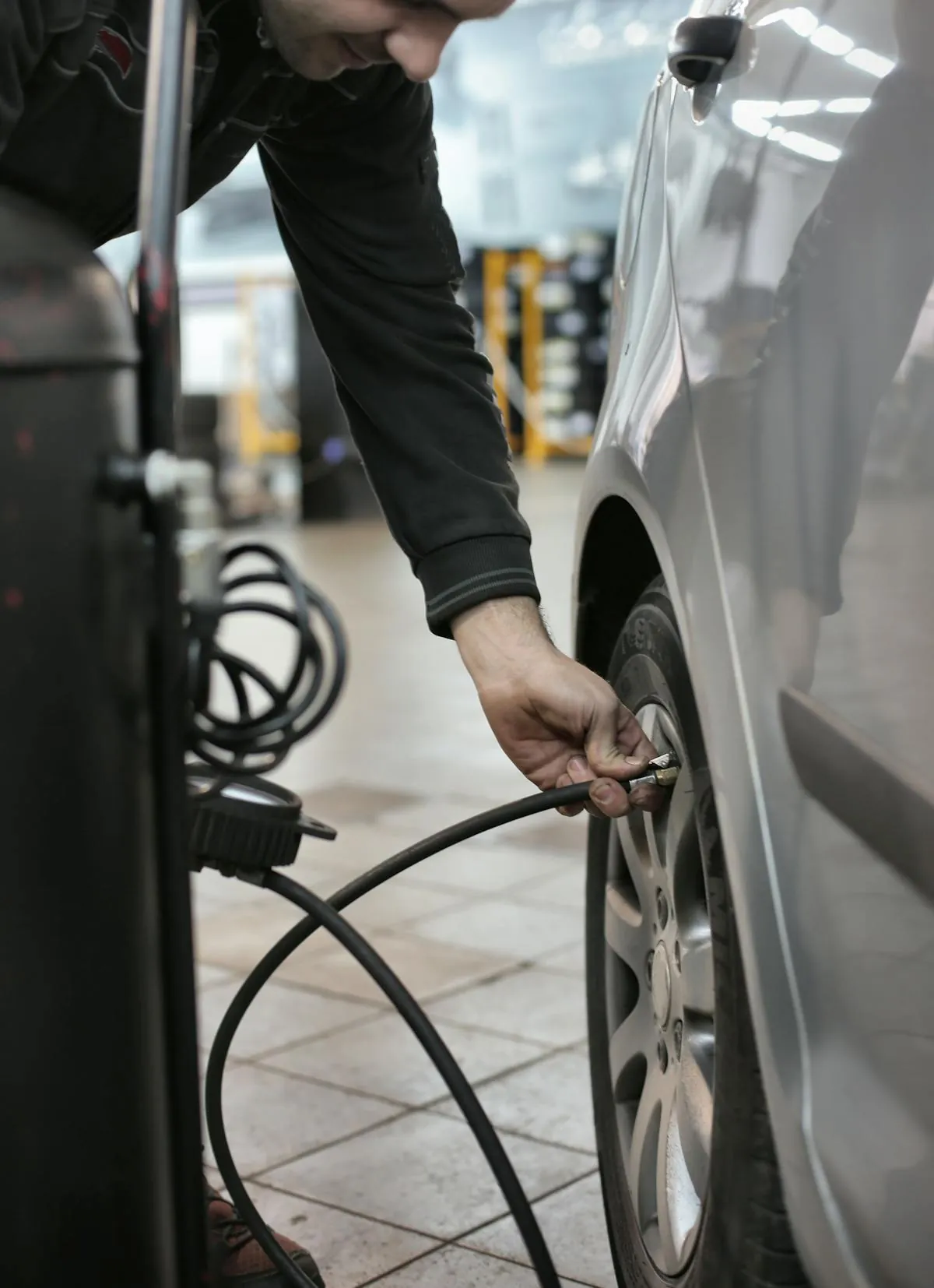
To clear the tyre pressure warning light on a Volkswagen Golf, set all four tyres to the pressures on the tyre pressure sticker while the tyres are cold, then store those pressures in the car as its new reference. The storing step is the one people miss. A Golf does not measure the air in your tyres directly. It watches how fast each wheel turns and compares that with figures it learned the last time someone pressed SET, so until you tell it what correct looks like now, it keeps comparing today's tyres against yesterday's numbers.
Where that SET lives depends on which Golf you have, and it has moved with each generation. Volkswagen's own UK guidance on the tyre pressure monitoring warning light puts it in one sentence: check and if necessary adjust the tyre pressure on all wheels, then store the tyre pressures using the menu display or by pressing the set button. Which of those two you get depends on your generation.
The Mk7 and Mk8 steps below are taken from Volkswagen's own Golf owner's manuals and cross-checked against Volkswagen's own quick start guides for the Golf, and each instruction says which cars it came from. The Mk6 is the one generation we could not pin to a Volkswagen handbook, and the post says so plainly rather than guessing. Volkswagen supplies handbooks by registration and VIN on its owner's manuals page. If your screens look different to the ones described here, your handbook wins.
Which tyre pressure system does your Golf have?
Not every Golf that watches tyre pressure actually measures it. Volkswagen uses two quite different designs, and the reset is only the same on one of them.
The one Volkswagen's current Golf manual describes is indirect. Volkswagen calls it the Tyre Pressure Loss Indicator on the current car, and the tyre monitor display on the Mk7. The current Golf owner's manual describes it like this: it is a tyre pressure monitoring system that uses data from the ABS sensors and other functions to check the speed of rotation and the rolling circumference of the individual wheels when the vehicle is in motion. A tyre that loses air gets very slightly smaller, so it has to turn a little faster to keep up with the others, and that difference is what triggers the lamp. No pressure is ever read.
The less common one is direct, with a radio sensor inside each wheel. The easy test takes a few seconds. If your car can show you an actual pressure figure for each individual wheel, it has sensors, and a failed sensor is a real possibility. If all it can do is warn you that a tyre is low and offer a SET or store option, it is the indirect type, and everything below applies.
| Generation | Roughly | System | Where the reset lives |
|---|---|---|---|
| Mk8 and Mk8.5, including Golf Estate, GTI, GTE, GTD and R | 2020 onwards | Tyre Pressure Loss Indicator, indirect, ABS based | Infotainment app overview, then Vehicle, Status, Tyre pressure, SET |
| Mk7 and Mk7.5, including Golf Estate, GTI, GTD, R and e-Golf | 2013 to 2020 | Tyre monitor display, indirect, ABS based | CAR button, then Vehicle settings, then tyre monitor display and SET |
| Mk6, including Golf Estate and Golf Plus | 2009 to 2013 | Indirect, ABS based, not verified here against a Mk6 handbook | A physical SET button, position varies, check your handbook |
| Mk5 and earlier | Before 2009 | Not verified here | Follow your own owner's manual |
If you want the background on how these systems differ before you touch anything, our explainer on what the TPMS warning light means covers both designs.
Before you reset: getting the Golf's pressures right
A reset stores whatever the tyres are currently at. Store them soft and you have simply taught the car that soft is normal, and the next real puncture will be further along before it warns you. So the pressures come first, every time.
- Find the sticker. The current Golf owner's manual says the sticker gives the correct tyre pressure for approved tyres and is located either on the driver door pillar or inside the tank flap. It covers the tyre sizes Volkswagen approves for the car, and it may list sizes that are not approved for yours, so read it against the size actually fitted.
- Read it cold, properly cold. The current manual is unusually specific: before measuring the tyre pressure on a cold tyre, park the vehicle for one hour out of direct sunlight. It also tells you never to reduce the raised pressure of a warm tyre, because that leaves you under-inflated once it cools.
- Match the load. The sticker symbols split into a tyre pressure for partial load and one for full load, and on some cars a comfort tyre pressure as well. The manual says the comfort pressure allows increased driving comfort and that fuel consumption may increase when you use it. The Mk7 manual adds that if the wheels are loaded more heavily than normal, for example with a heavy payload, the tyre pressure must be raised to the recommended full-load pressure before calibration.
- Do it monthly. Volkswagen's instruction is to check tyre pressures regularly, at least once a month and before every long journey, and to check the spare or temporary spare monthly too, monitoring system or not. TyreSafe's tyre pressure guidance says pressures should be checked regularly, and points drivers to the manufacturer's handbook, the fuel filler cap or the driver's door sill for the figures.
We have deliberately not printed any numbers here. Golf pressures change with engine, wheel size and load, and a figure lifted from a forum for a different car is worse than useless. Read your own sticker.
How to reset the tyre pressure light on a Golf Mk8 (2020 onwards)
On the Mk8 and the facelifted Mk8.5, Volkswagen calls the reset adapting or re-synchronising the Tyre Pressure Loss Indicator. The steps below are as printed in the Volkswagen Golf owner's manual for the eighth-generation car. Volkswagen's own quick start guide for the MY24 Golf gives the identical sequence in American wording, which is a useful second check if your handbook is not to hand.
Two conditions have to be met before the car will let you do it. All the tyres must be at the correct pressure measured cold. And if a low tyre pressure warning is currently showing, the manual says you cannot calibrate the Tyre Pressure Loss Indicator until you have met one of two conditions: switch the ignition off and then back on again, or wait for 60 seconds with the engine running and the vehicle stationary.
- Open the app overview in the Infotainment system.
- Tap Vehicle.
- Tap Status.
- Tap Tyre pressure.
- Tap SET.
- When all four tyre pressures correspond to the required values, tap OK.
What happens next is your confirmation that it worked. The manual says the indicator lamp flashes for around 6 seconds, an acoustic signal sounds and a text message appears on the instrument cluster display. After an extended driving time of at least 20 minutes at different speeds, the system automatically learns the new values and monitors them. So a quiet dashboard on the first mile is not proof of anything yet.
One detail worth knowing: if the lamp flashes for around 6 seconds when you have not just adapted the system, the manual tells you to go immediately to a suitably qualified workshop. It is also blunt about doing the reset at the wrong pressures, warning that an indicator adapted when the pressures are too high or too low may issue incorrect warnings, or fail to warn at all even though a tyre is dangerously low.
Volkswagen lists the situations that mean you must adapt it again: the tyre pressures have been changed, one or more wheels have been changed, or the wheels have been swapped round, for example from front to rear. Two seasonal ones are easy to forget. The manual says the system has to re-synchronise after changing to winter tyres, and that it must be re-synchronised when snow chains are fitted. It also states plainly that the Tyre Pressure Loss Indicator does not work if there is a fault in the ESC or ABS, because it borrows their wheel speed data.
Golf Mk7 and Mk7.5 (2013 to 2020): the CAR button route
The Mk7 calls the same feature the tyre monitor display. It is the same indirect design, reading the wheels rather than the air in them, and the Mk7 manual lists it in the Vehicle settings menu as store the tyre pressures (SET). The manual says the tyre monitor display will have to be re-calibrated after changing the tyre pressure, or after changing one or more wheels, and that this also applies when wheels are swapped, for example from the front to the rear.
The manual opens that menu by switching on the ignition, switching on the infotainment system if needed, pressing the CAR infotainment button and touching the function button for the Vehicle settings menu. Put together, the steps for this generation are:
- Switch on the ignition.
- Press the CAR infotainment button.
- Touch the function button to open the Vehicle settings menu.
- Touch the tyre monitor display function button.
- Touch the SET function button.
- If all 4 wheels are set to the correct values, touch Confirm to store the tyre pressures.
Touching Cancel instead, the manual warns, prevents the current tyre pressures from being stored and the system is not calibrated. If that happens the pressures have not been stored, and the light can come back within days.
Menu names shifted slightly across the Mk7 and Mk7.5 years and across the different screens Volkswagen fitted, so do not expect the labels to match to the letter. Volkswagen's own quick start guide for the MY21 Golf gives the same job as ignition on, press the CAR infotainment button, select Setup, select Tire settings, select SET, then select Confirm to store, and adds that the new pressures are stored after roughly 20 minutes of normal driving. If your car offers a Setup route rather than a Vehicle settings one, that is the same menu under a different name.
After the reset the car keeps working on it. The Mk7 manual says that during normal vehicle operation the system calibrates itself independently to the fitted tyres and the pressures the driver has put in, and that the calibrated values are accepted and monitored after a long journey at various speeds. It also repeats the ABS point: the Tyre Pressure Monitoring System stops working if there is a fault in the ESC or ABS.
Golf Mk6 (2009 to 2013): where is the reset button?
On a Mk6 the reset is a physical button rather than a menu, and this is the one generation where we are not going to print a step you can hold Volkswagen to. We could not get hold of a Volkswagen Mk6 Golf handbook to verify where the button sits on your car, and the honest answer is better than a confident wrong one: look it up in your own handbook before you go hunting.
What is certain is the shape of the job, because Volkswagen's own guidance on the tyre pressure monitoring warning light covers its whole range in one instruction: check and if necessary adjust the tyre pressure on all wheels, then store the tyre pressures using the menu display or by pressing the set button. A Mk6 is the set button half of that sentence. In general terms, not checked against a Mk6 handbook:
- Set all four tyres to the correct cold pressure for the load you are carrying, using the sticker on the car.
- Switch on the ignition.
- Press the tyre pressure monitoring button and hold it until the car acknowledges the new pressures.
- Drive normally and let the system settle to the stored values.
To find the button, use the overview of the vehicle chapter at the front of your handbook rather than the tyre chapter. That chapter has labelled diagrams of the driver side, the centre console and the front passenger side, and those diagrams show where the button is and how it is marked. Volkswagen did not fit the system to every Mk6, and equipment varied by trim and by market, so a car with no such button and no tyre pressure entry in its menus may simply not have it. If no tyre pressure symbol lights briefly when you switch on the ignition, that is a fair sign there is nothing to reset.
One thing does apply to the later Mk6 cars whatever the button situation. The DVSA's MOT rules bring tyre pressure monitoring into the test for M1 vehicles first used on or after 1 January 2012, so a 2012 or 2013 Mk6 is in scope and a 2009 to 2011 car is not.
Does the Golf Estate, GTI or R need anything different?
No. Volkswagen prints one Tyre Pressure Loss Indicator procedure for the Golf, not a different one per body style or trim. Where the tyre chapters do separate the sportier cars out, it is over things like the snow chains each one can take, which are listed model by model for the Golf, Golf GTD, Golf GTI, Golf GTI Clubsport and Golf R, rather than over how you store the pressures. The menu path on an Estate is the menu path on a hatch of the same age.
What does change is the numbers you feed it, and that matters more on an Estate than on anything else in the range.
- Load. The sticker gives separate figures for partial load and full load. An Estate spends far more of its life near the second one. Set the full-load pressures before you reset if that is how the car is being used, or the system learns a reference that is wrong for the way you drive.
- Bigger wheels, thinner sidewalls. GTI, GTD, GTE and R models, and any Golf on optional large alloys, run lower profile tyres that show less visible sag when they are down on air. The lamp may well be the first thing that tells you, which is an argument for treating it seriously rather than resetting it.
- Run-flats. A Golf on run-flat tyres gives you even less to see, because the sidewall is built to hold the car up. Our guide to run-flat tyres explains what that means in practice.
- Space saver or breakdown kit. If a temporary spare goes on, the rolling circumference is wrong by design. Get the proper wheel back on, set it cold, then reset.
Steady light or flashing light: what each one means
How the symbol behaves tells you whether to look at the tyres or at the system. Volkswagen's manuals and the DVSA both draw the same line.
| What you see | What Volkswagen says it means | What to do |
|---|---|---|
| Lamp lights up and stays on | Loss of pressure in one or more tyres, or the tyre is structurally damaged. On the Mk7 an acoustic warning sounds with it | Current manual: stop immediately in a place that is safe from traffic and check all tyres. If the tyre is not flat and the wheel does not need changing straight away, drive at low speed to the nearest suitably qualified workshop and have the pressure checked and corrected. The Mk7 manual is blunter still: do not drive on, reduce speed immediately, avoid swerving manoeuvres and heavy braking, then check all tyres and pressures |
| Lamp flashes for about a minute, then stays on | A fault in the system itself | Switch the ignition off and back on, re-synchronise, and if it persists have the system checked. Keep checking all four tyres with a gauge in the meantime |
| Lamp flashes for about 6 seconds (Mk8) | Normal if you have just stored the pressures. Not normal otherwise | If you did not just reset it, the manual says go immediately to a suitably qualified workshop |
| Lamp is slow to appear, or nothing shows at all | Both manuals note the system may react with a delay, or not display anything, with a sporty driving style, on snow-covered, icy or unsurfaced roads, or when driving with snow chains | Do not read silence as a clean bill of health. Check all four with a gauge, then re-synchronise |
The DVSA describes the same behaviour from the tester's side. Its MOT inspection manual notes that the warning lamp will generally illuminate and go off again when the ignition is switched on, that a lamp which stays on may simply mean a previous pressure loss rather than a fault, and that in the event of a system malfunction the lamp may flash a number of times and then remain on.
Why the Golf's tyre pressure light keeps coming back after a reset
If the light clears and then returns within days, the reset was not the problem. Something else is. These are the possible causes:
- The tyre is still losing air. A nail or screw in the tread, a leaking valve or a poor seal between the tyre bead and the rim will all bring the lamp straight back. Treat it as a slow puncture until proved otherwise, and see slow puncture causes and fixes for how to find it.
- The pressures were set warm. Air expands as it heats, so a tyre topped up after a motorway run reads high and is actually low once it cools. That is why Volkswagen asks for an hour parked out of the sun before you measure.
- Cold weather. Nothing has gone wrong; the air in the tyre has simply contracted. A cold snap can put the lamp on overnight.
- Something changed and nobody re-synced. Winter tyres fitted, snow chains on, wheels rotated, a wheel off and back on. Volkswagen calls for a fresh reset in every one of those cases.
- An ABS or ESC fault. Both manuals say the tyre pressure system simply stops working when the ABS or ESC has a fault, because it is reading their wheel speed sensors. Fix that and the tyre lamp usually goes with it.
- Brand new tyres. The manual notes that new tyres driven at high speed for the first time can expand slightly and trigger a one-off pressure warning.
- A failed sensor, on the cars that have them. If your Golf reads individual pressures, a dead sensor will keep the lamp on however many times you reset. Our guide to TPMS sensor replacement covers what that involves.
Is it safe to drive a Golf with the tyre pressure light on?
Not normally, and not far. The current Golf manual's instruction when the lamp lights is to stop immediately in a place that is safe from traffic and check the tyres, and the Mk7 manual goes further and says do not drive on. Both add the same caution: the system only warns about pressure loss and does not remove the need for regular maintenance and inspection of tyres.
- On a motorway, do not stop on the carriageway to look. If the car handles normally, slow down, leave at the next junction or services, and check the tyres there; if not, use the hard shoulder or an emergency area. If you feel in danger, call 999. National Highways can be reached on 0300 123 5000.
- Stop straight away if the steering pulls, you hear flapping or rumbling, or the tyre is visibly flat. Driving a deflated tyre wrecks the sidewall in a very short distance and turns a repairable puncture into a replacement tyre.
- A flashing light means the car may no longer be able to warn you about a genuine pressure loss, so check all four with a gauge until it is fixed.
There is an MOT angle as well. The DVSA's MOT inspection manual for cars and passenger vehicles lists a tyre pressure monitoring system that is malfunctioning or obviously not working as a major defect, and says the TPMS inspection applies to M1 vehicles first used on or after 1 January 2012. That covers every Mk7 and Mk8 Golf and the later Mk6 cars. The same manual records an obviously under-inflated tyre as a minor defect, so a lamp that is on simply because a tyre is low is worth sorting before the test rather than explaining at it.
When to get a mobile fitter out to your Golf
Call rather than keep pumping it up if:
- the light returns within days of correcting the pressures and storing them
- one tyre keeps going down, or you can see a screw, a cut or a bulge
- the lamp flashes, or stays on after new tyres or a wheel swap
- the tyre is too soft to drive on safely
Rescue Tyres is a fully mobile tyre and wheel service covering London, the Home Counties and the Midlands from one base at Brent Cross, NW2. Evenings, nights and weekends are covered when the diary allows, at the same price as a weekday job. Our fitter checks all four pressures against your Golf's own sticker, inspects the tread, sidewalls and valves, and carries out puncture repairs to BS AU 159 where the damage is inside the repairable area. If the tyre cannot be repaired we source a replacement in the correct size, including run-flat and larger GTI and R sizes, and fit and balance it where the car is parked. If the fault turns out to be the monitoring system rather than the tyre, you will be told that plainly.
The price is confirmed on the call before any work starts, and a realistic arrival time is agreed on the call. Phone or WhatsApp 07473 720871.
