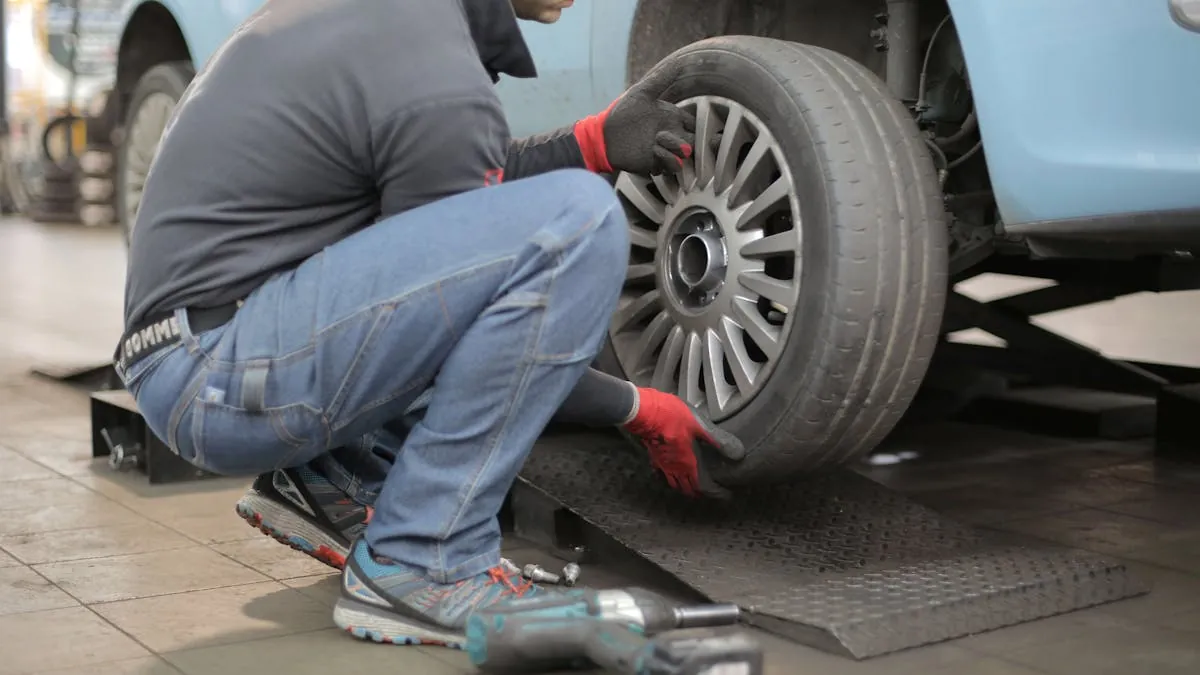
A flat tyre in the airport car park is easy to come back to, because cars stand for days or weeks while you're away. A mobile fitter can come straight to the car park and repair or replace the tyre, so you drive home safely instead of risking a flat or arranging a tow.
Why flats happen at airports
A long stay is hard on tyres. A slow puncture you didn't notice before you flew can deflate fully while you're away, a tyre can lose pressure standing in the cold, or a sharp object picked up on the way in finishes the job overnight. The result is a flat waiting for you in the car park exactly when you least want it. It's why TyreSafe advises checking your pressures before any long journey: a quick look before you set off for the airport can flag a soft tyre before it strands you on the return.
What to do when you land
If you spot a soft or flat tyre, don't start a long drive home on it. Park safely, note your terminal and car park, and call a mobile fitter. If you realise before you land (some people check tyre-monitoring apps), you can call ahead, and we will tell you whether we can take the job and give you the arrival time. Heathrow and Luton are within reach of our Brent Cross base; Birmingham Airport is about 90 miles (straight line) away with no van stationed near it, so for Birmingham and any other airport we tell you on the call whether we can take the job and give the arrival time then.
Repair or replace on the spot
If the puncture is a simple one in the tread, we can often repair it on the spot. If it's not safely repairable, we fit a replacement in the car park (common sizes are often on the van; other sizes are sourced for the job), balanced and inflated, and take the old tyre away. Either way you leave the car park on a sound tyre, see how mobile fitting works.
Don't drive home on a flat
It's tempting to "just get home", but driving on a flat ruins the tyre and risks the wheel and your safety, see driving on a flat. After a long flight, on a motorway home, that's the worst time to take the risk: an underinflated or damaged tyre is far more likely to suffer a blowout at speed. A mobile fit is the safer, simpler choice.
Airports we reach
Heathrow and Luton sit inside areas we cover for home and roadside fitting. Birmingham Airport is about 90 miles from our only base at Brent Cross, so the arrival time there is given on the call. Give us the airport and car park name when you call.
| Airport | Where it sits | Notes for fitting |
|---|---|---|
| Heathrow | London Borough of Hillingdon | Car parks range from surface long-stay to terminal multi-storeys, which can have height limits, so tell us the level and bay. |
| Luton | Luton, Bedfordshire | Most long-stay parking is surface level and a short shuttle from the terminal. Meet-and-greet operators return the car to a set point. |
| Birmingham | Solihull borough, beside the NEC | Large surface car parks around the terminal. It is about 90 miles from our Brent Cross base, so we tell you on the call whether we can take the job. |
Gatwick, Stansted and the other regional airports are further from our Brent Cross base, so the journey to you is longer and we will tell you honestly whether we can get to you or whether a local fitter makes more sense.
What the fitter needs from you
Five pieces of information get a fitter to the right bay with the right tyre: airport, car park, level and bay, registration, and a photo of the tyre. Airport car parks are enormous, and "the long-stay at Terminal 3" can be thousands of spaces.
- Car park name and zone. It is on your booking confirmation and on the signs at the bus stop. Note the row or bay letter as you walk back to the car.
- Registration. It helps the fitter find the right car. A photo of the sidewall gives the exact size and speed rating.
- A photo of the damage. A nail head in the tread is probably a repair; a bulge, a cut or a tyre that has been driven flat is a replacement. Knowing which saves a second trip.
- The locking wheel nut key. Find it before we arrive. If it is missing, say so, and we bring the removal tools.
- Your phone number and where you will be. Stay with the car or nearby so the fitter can reach you.
If you used a meet-and-greet service, the car will be brought to a handover point. Ask the operator whether the fitter can work there or whether they can move the car to a quieter part of the car park.
Before you fly: a two-minute check
An airport flat can be a slow puncture that started before the holiday, so the cheapest fix is a quick look before you leave the house. A tyre that is a few PSI down when you park will be flat, and possibly damaged, after two weeks.
- Set all four pressures cold to the placard figure the day before you fly. A tyre that has dropped overnight is telling you something.
- Walk round the car in the airport car park before you leave it, looking for a screw head or a tyre that sits lower than its partner. A puncture is far easier to deal with before your flight than after.
- Do not leave the car with a tyre already showing a TPMS warning. The light means it has already lost a meaningful amount of air.
- If the car will stand for several weeks, a pressure towards the placard's laden figure helps avoid flat spots. Reset to the normal figure when you get home.
When you get back, look at the tyres before you load the luggage. A tyre that has gone completely flat over two weeks has been sitting crushed under the weight of the car, which can damage the sidewall even if the original puncture was tiny.
Rolling it a hundred metres to the exit barrier can finish it off, which is why we ask you to leave it where it is.
Run-flats, sealant kits and the drive home
What you can do yourself in the car park depends on what the car came with, and none of the options is as good as fixing the tyre before you drive.
Run-flat tyres are built to carry the car a limited distance at reduced speed after losing pressure; handbooks typically quote around 50 miles at up to 50mph.
That is enough to reach a safe place, not enough for a drive home up the M1, and a run-flat that has been driven deflated normally cannot be repaired. See run-flat tyres explained.
A sealant kit will get a small tread puncture holding air for a slow drive to a fitter, but it makes a mess inside the tyre, can ruin a TPMS sensor if left, and rules out a proper repair with some brands.
It is also useless on a sidewall cut or a tyre that has been flat for a fortnight.
A space-saver spare is the best of the three for getting moving, but it is limited to around 50mph, and after a long flight you do not want a long, slow drive on a narrow temporary tyre. Fitting it in a busy car park lane, tired, in the dark, is its own risk.
Whichever you have, the drive home after a flight is when tiredness bites. The Highway Code recommends a break of at least 15 minutes every two hours (rule 91), and if you have been travelling all day, take a proper break before the drive home.
We come to the car park
From our base at Brent Cross we cover Heathrow and Luton car parks. For Birmingham, Gatwick, Stansted and other airports we tell you on the call whether we can take the job, and give the arrival time then. Call us when you land.
